Jordan Satchell discovered an interest in sign language early on, an interest that was reinforced in high school when she took sign language as a foreign language. By the time she made it to college, she was uncertain of what path to follow until she realized her school offered a sign language interpreter program.
“I switched majors the very next week,” Satchell said.
That was at the University of North Carolina at Greensboro, and after graduation, she attended the University of North Florida where she graduated with a master’s degree in American Sign Language (ASL) and English Interpreting.
Satchell didn’t learn specific medical sign language skills, but she eventually found herself working in the emergency department (ED) at ECU Health as an experience coordinator.
A door opens in Language Services
While working in the ED, Satchell’s manager introduced her to Reid Barnes, the ASL coordinator with Language Services at ECU Health.
“Reid told me about this new residency program and suggested I apply, which I did,” Satchell said. “I thought nothing would come of it, but they picked me.”
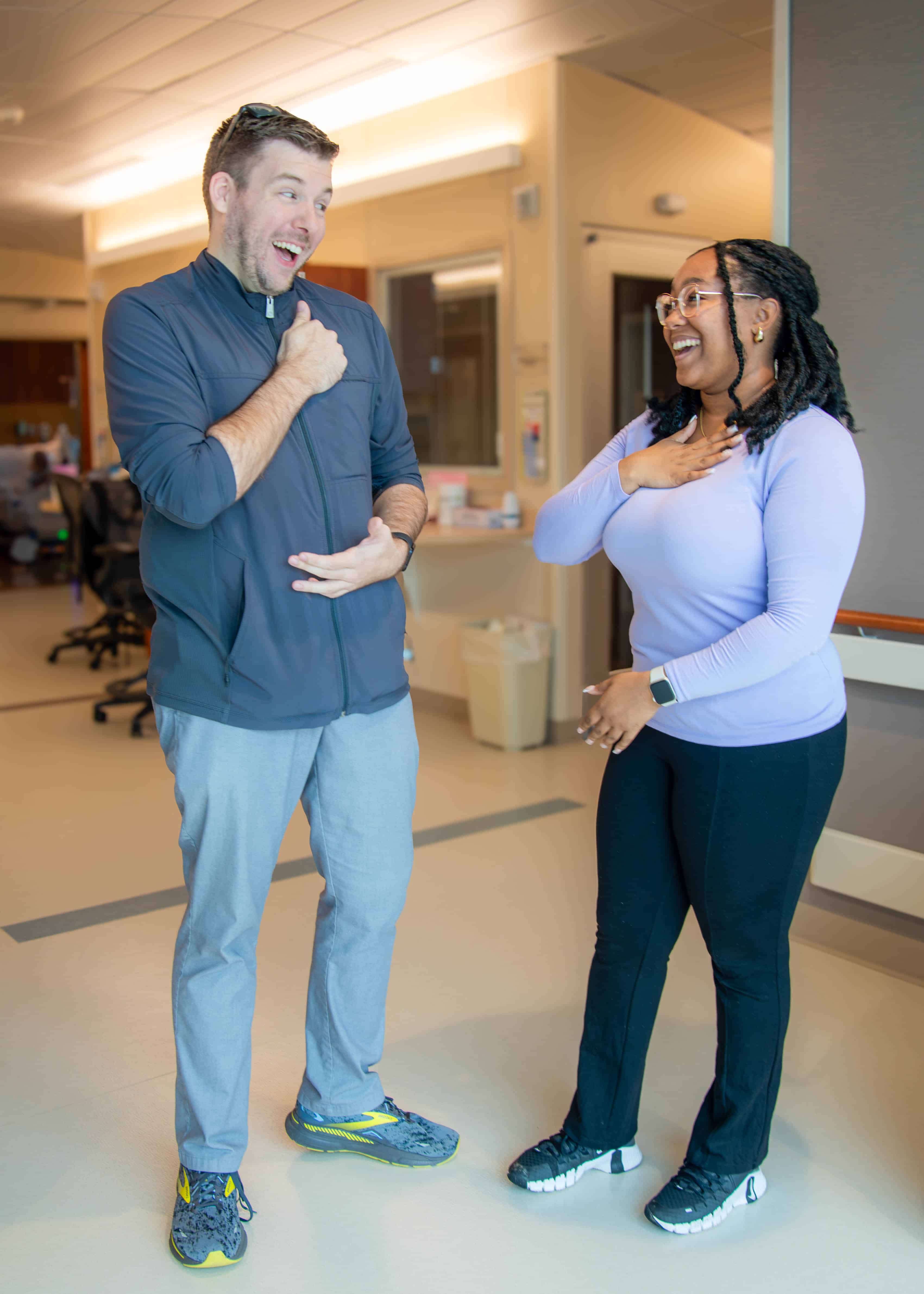
The two-year residency is a first, not only for ECU Health, but for the country.
“ASL interpreters are trained as generalists,” Barnes shared. “They are equipped to interpret in any setting, but if they want to pursue specialized training, that’s up to their discretion.”
ECU Health’s American Sign Language Residency program was developed to improve medical interpreting for individuals wanting to hone their skills and understand medical and health care systems. While interpreters in North Carolina must hold and maintain a state license to practice, and national certification is required for a full North Carolina Interpreter and Transliterator Licensing Board (NCITLB) license, there is no additional training required for specialization. That makes this program unique.
As the first resident, Satchell has helped build the program by providing Barnes with feedback, and it didn’t take her long to get started advancing her skills. During her first week, she was called down to outpatient rehabilitation to help with a patient in their speech language pathology appointment.
“The next time, I was called down to the ED,” Satchell added. “Reid was off campus so he asked me to go. The patient was hearing, but they had a Deaf family member. The meeting turned into a palliative care conversation and that really hit me because I’m such a softy, and the family was crying.”
Satchell explained that as an interpreter, she doesn’t speak in third person; she speaks as the person for whom she is interpreting – which can make conversations personal.
While the work can be challenging, Satchell said Barnes has been supportive.
“He’s been a great mentor. When I doubted my ability, he reassured me and that helped with my training and my confidence,” Satchell said.
Ready for the next step
Now that her residency is nearly complete, Satchell said she feels prepared for her future career plans.
“This program doesn’t just help with medical interpreting,” she said. “It also refined how I work with people. Working here has 100% prepared me for working in this field.”
“Jordan’s growth during her time with us has surpassed any expectations,” Barnes shared. “She’s improved her technical skills (ASL signs and technical jargon) as well as her soft skills (flow of interpretation and customer service). She’s demonstrated problem solving and system navigation, and she’s helped educate providers and assisted with conference presentations. Her time with ECU Health will benefit her regardless of where she goes next.”
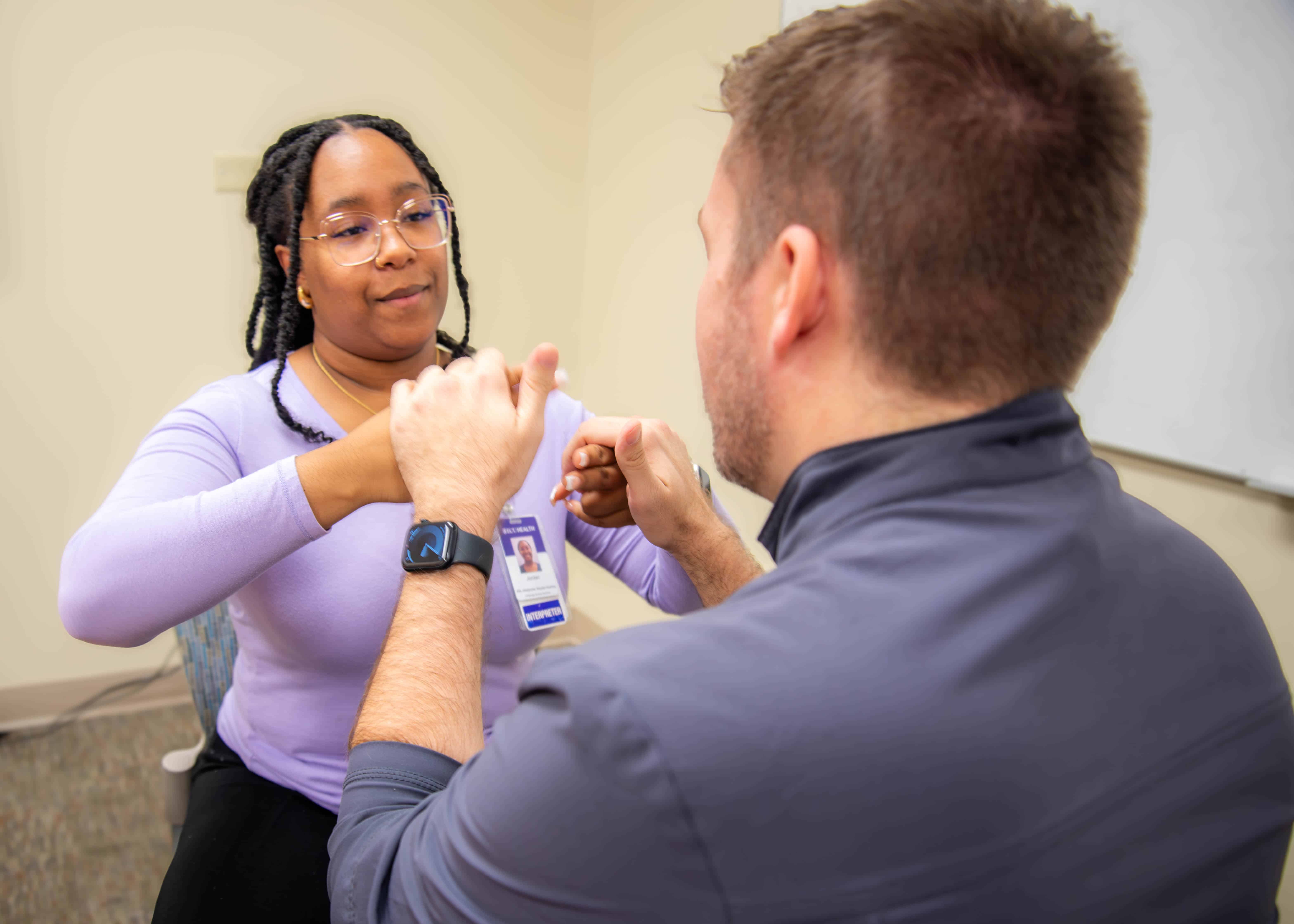
ASL is the third most common language in the United States, after English and Spanish, yet Jordan said many people are unaware of the need for ASL interpreters and the service they provide, especially in a medical setting.
“There is an improved continuity of care with Deaf patients when they have interpreters,” Satchell explained. “A lot of people don’t realize that patients not having access to their native language impacts their understanding of medical advice and information. Having access to an interpreter makes patients more likely to seek and follow through with the medical care they need.”
Barnes said they are recruiting for the next ASL resident to continue growing the pipeline for interpreters with medical specialization. Those who are interested in learning more about the program can reach out to [email protected].
“There’s no program like this in the country. Bigger states, like California, don’t have anything like this,” Satchell said. “There’s no program designed in a hospital where you have training like this, and the hope is we can grow this program to host more interpreters at more locations.”