“There’s not a day I’m not learning, and I’m beyond where I thought I’d be a year ago.”
That’s what Dr. Jan Lopes, second-year fellow in the ECU Health’s Clinical Cardiac Electrophysiology Fellowship, said about his experience thus far. The first of its kind at ECU Health, and the first accredited electrophysiology program in this region, the electrophysiology (EP) fellowship only accepts one fellow a year. Dr. Lopes is halfway through his two-year fellowship, and a new fellow, Dr. Jeffrey Foley, began in July.
Filling a need
Electrophysiologists treat heart rhythm disorders and heart failure with electric devices inserted into the heart. As part of the fellowship, doctors will learn about pacemakers, defibrillators, implantation, ablations, leadless pacemakers and left atrial appendage closure devices.
The goal is to address the shortage of electrophysiologists in the nation, but specifically to train and retain physicians in eastern North Carolina.
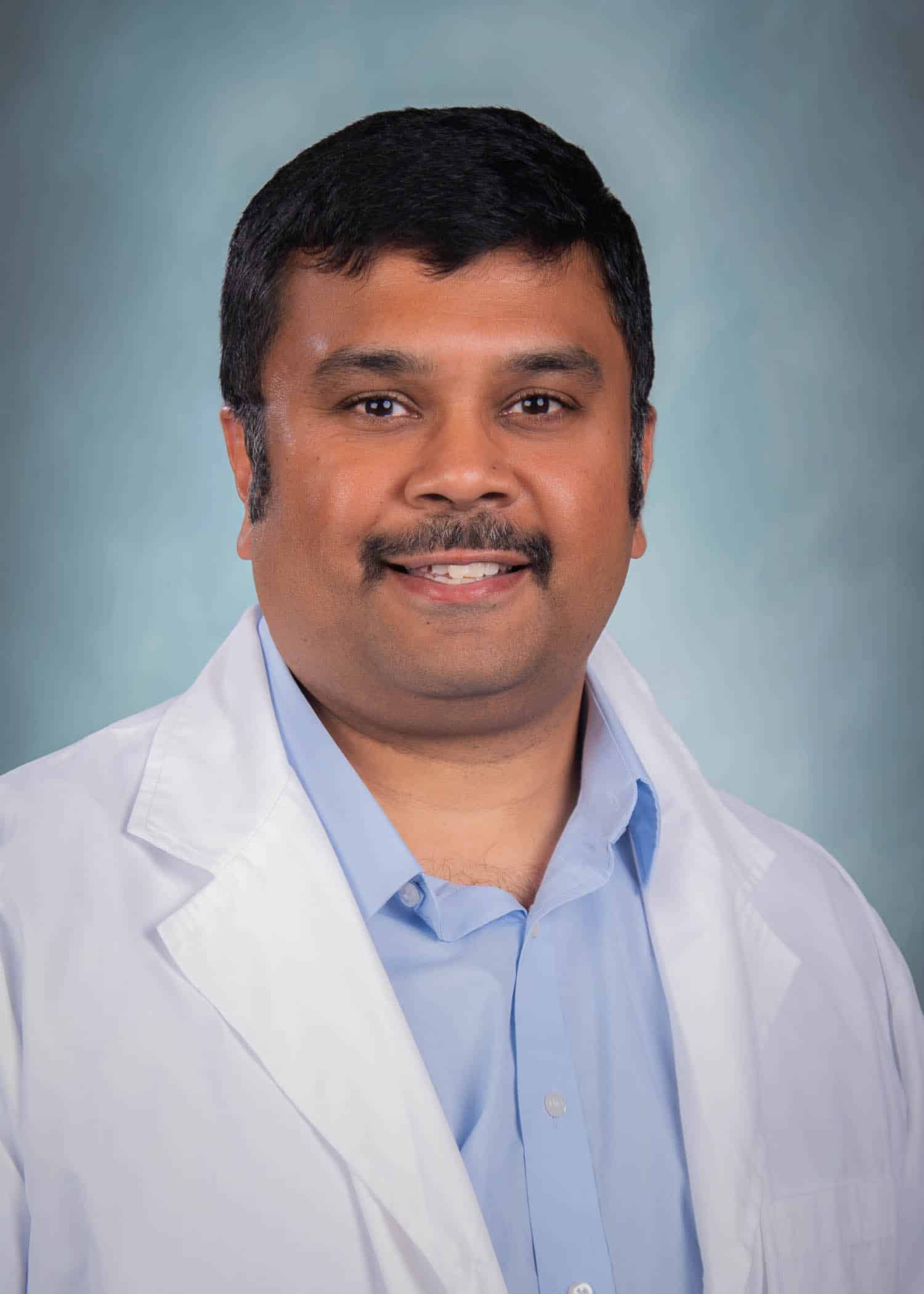
Dr. Ghanshyam Shantha
“As heart rhythm disorders increase in prevalence, it’s feels good to be a part of something that will help support the needs of those in our community,” shared Mamie McCray, the ECU Department of Cardiovascular Services Fellowship Program Coordinator. “This experience has been fruitful, and I look forward to more exceptional outcomes as we grow.”
Dr. Ghanshyam Shantha, the new program director for the fellowship, is excited to work with the fellows. “Both Jan and Jeff are great with patients and natural learners,” he said. “I consider myself privileged to mentor young minds and help them see their dreams come true.”
“The first year involves significant growth and adaptation,” said Dr. Rajasekhar Nekkanti, the fellowship’s associate program director. “Fellows transition from general cardiology to a demanding subspecialty, facing new environments and board exams. The program builds knowledge and competency incrementally. In the initial months, fellows focus on procedures like pacemaker and ICD implants and less complex ablation procedures. As skills develop, they progress to more complex procedures.”
One year in
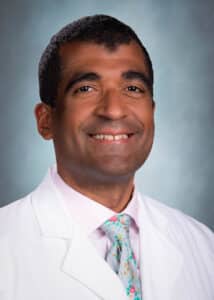
Dr. Jan Lopes
Now that he’s halfway through the fellowship, Dr. Lopes said he’s learned a lot by being a trail blazer.
“I was the first fellow and that’s been fortunate because I’ve been able to tailor this program to what I need. The faculty are open and flexible, and while there are guidelines to be followed, there’s a lot I can choose from and try. The level of freedom I’ve been given has provided me a lot of hands-on experience.”
Having a diverse faculty – both in when and where they studied – has also been influential.
“This means I get to see different ways of doing things. It has helped me be more resourceful because I’ve been trained in multiple ways.”
That support has prepared Dr. Lopes for a fulfilling future in cardiology.
“This is a program in demand at a large hospital with a significant patient population. In this fellowship, I can focus on my education. I have a great support system, and the work is meaningful. I’m confident that after graduation I’ll be fully capable of caring for my patients in Texas.”
It was a sign
Dr. Jeffrey Foley, a California native who completed his fellowship in general cardiology in Kentucky, began his fellowship in July. Like Dr. Lopes, he happened upon this fellowship by chance.

Dr. Jeffrey Foley
“My wife’s family always goes to Holden Beach [North Carolina] every year for a family vacation, and we’ve driven through North Carolina many times before,” he shared. “A year or so ago, we were driving through and a billboard for ECU Health Medical Center caught our attention. We’d never heard of ECU Health before. When I was applying for fellowships, I applied to ECU Health. It was perfect because we were already familiar with the area and love it here. And we like Greenville’s vibe with the college and lots of activities.”
Dr. Foley said he was drawn to electrophysiology after learning about fluid and electromagnetic physics.
“I love the technology. It makes sense to me, and I love being able to get in there, find the problem and solve it with instant gratification.”
He hopes the fellowship will give him many hands-on opportunities.
“I anticipate the first year being about becoming a confident, independent provider,” he said. “I want to do all the procedures and use the equipment smoothly and without hiccups. In the second year I hope to fine-tune those skills.”
“The program hopes to produce expert clinicians and empathetic caregivers, especially in underserved areas and rural settings, where access to specialized electrophysiology care can be limited,” said Dr. Nekkanti. “This includes patient-centered care, efficient resource use and research participation to address community need.”
In the future, Dr. Shantha and Dr. Nekkanti hope to expand the program further, including increasing clinical research, establishing the clinic as an Atrial Fibrillation Center for Excellence and representing ECU and ECU Health at international conferences.