It was a quiet day in the cardiology clinic when the echocardiogram technician at ECU Health Beaufort Hospital asked Michael Joyner, a nurse practitioner, for a favor.
“My schedule wasn’t full because I had only been working at that location for about a month, and the echocardiogram tech had a student,” Joyner said. “Their patient didn’t show up, so she asked if her student could practice using the equipment on me.”
When the student viewed Joyner’s heart, however, something unexpected showed up.
“I knew I had a heart murmur, but the technician looked concerned and took over the scan. Turns out my aortic root was dilated to more than twice its normal size,” he said.
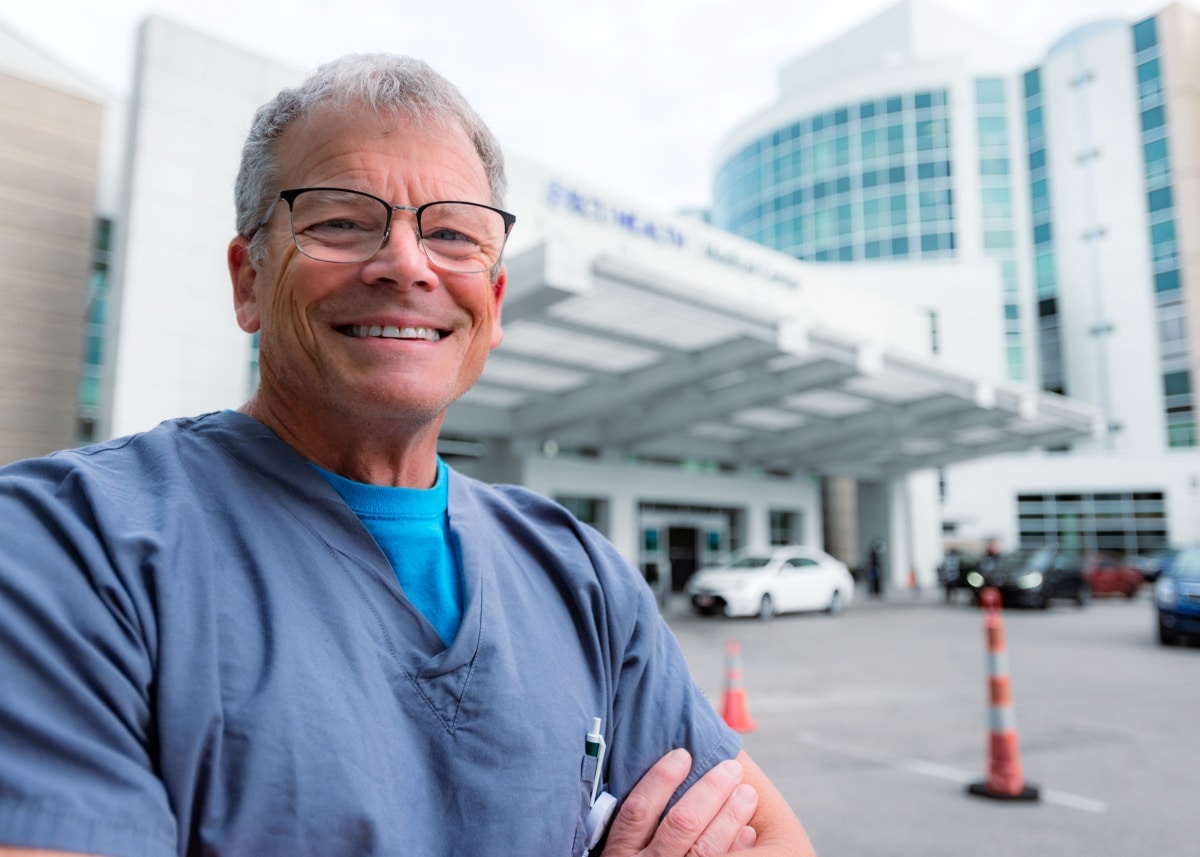
The aortic root is where the aorta, the largest blood vessel in the body, is closest to the heart. A dilation, otherwise known as an aneurysm, is potentially life threatening.
“When you research aortic aneurysms, one of the first things you read is that the first symptom is often sudden death,” Joyner said. “They’re often asymptomatic, but if it ruptures, usually the only thing people can do for you is hold a funeral service.”
Help was only a call away
After the scan, Joyner spoke with a cardiologist immediately. It helped that he knew trusted team members from across the system.
“I asked one of my former students and a nurse practitioner, Brooke Kostok, if her colleague, Dr. Ben Degner, could look at my echocardiogram,” Joyner said. “He called me personally that afternoon and spent 20 minutes on the phone outlining what he thought about it and his recommended next steps. He didn’t have to do that.”
After a computerized tomography (CT) scan and an official diagnosis, which showed the amount of dilation was borderline, Michael and his physicians opted for a watch and wait approach.
“I had a new grandson on the way, and I didn’t want to be recovering from surgery during that time,” he said.
A repeat echocardiogram in the fall of 2025 showed the dilation had grown by a small amount. Joyner decided it was time to have surgery, and on Oct. 21, he underwent an aortic root replacement with aortic valve replacement and reimplantation of the coronary arteries – also known as the Bentall procedure.
“It was a long surgery, and I was lucky to have a network of people I could rely on for support, including Chris Baxter, a certified registered nurse anesthetist (CRNA), who was with me during the surgery,” Joyner said. “I wanted him at the head of the bed during my surgery because I had full confidence in him.”
Other colleagues provided support during the surgery by placing a PICC line or being present and supportive for Joyner’s wife, Gwin, and their son.
Recovery went well until day three, when Joyner experienced some post-operative atrial fibrillation – a not uncommon event after this type of surgery. Another former student, D.J. Smith, ACNP on the CVICU, helped restore Michael’s normal heart rhythm.
After seven days in the hospital, Joyner went home, but six weeks later, a post-operative CT scan showed some leakage at the site where an intraoperative cannula had been placed. He needed another surgery in December 2025.
Looking forward to the future
Taking nearly four months off work and undergoing two surgeries has been tough, but now Joyner is feeling better every day.
“It’s difficult to reconcile that you need surgery when you feel healthy. And when you work in health care, you know what could go wrong,” he said. “To have two surgeries – to have your chest opened twice – that’s a difficult recovery.”
Despite the mental and physical challenges, Joyner is clear about his perspective of gratitude.
“I don’t believe in coincidence,” he said. “So many things had to happen to get me where I am. I had to find out about the job at Beaufort – because I wasn’t looking for a new role – and then get the job. I had to be in the clinic that day and not have a patient. The echocardiogram tech had to have a student and a patient cancellation. It was a series of events coordinated by God.”
Joyner is scheduled to return to work in March, and he’s thankful to all the people who played a role in his diagnosis and recovery – especially his wife.
“Gwin is also a nurse at the hospital, but during this time she was my personal nurse and physical therapist,” Joyner said. “I’m fortunate to work in a profession where I was in the right spot at the right time, and to have a whole network of people I can call. That’s made the difference for me.”