When Ashley Dunn, a quality nurse specialist on the ECU Health Medical Center patient safety team, graduated from nursing school in 2008, she found a place in Pitt County Memorial Hospital’s labor and delivery unit. She loved her team and her work, but in 2014 she was sidelined with an unexpected diagnosis.
“I found out I had cystic fibrosis, which I was not expecting. That took me away from the bedside, so I worked in outpatient case management with Access East until 2016.”
Ashley then switched to working in the post anesthesia care unit (PACU), but the pandemic required another change.
“My doctors did not want me anywhere near the bedside, but I still wanted to work with the hospital. That’s when I found this role in patient safety. Everything fell into place like it was meant to be.”
An unexpected journey
Around the same time she joined ECU Health, Ashley and her husband, David, also wanted to grow their family. Despite polycystic ovary syndrome (PCOS), her cystic fibrosis diagnosis and the everyday stress of life and work, Ashley said she and David assumed things would work out.
“Nothing was happening,” she said. “We didn’t feel pressed to do IVF early on, but then suddenly I was 37 and we felt like we were running out of time.”
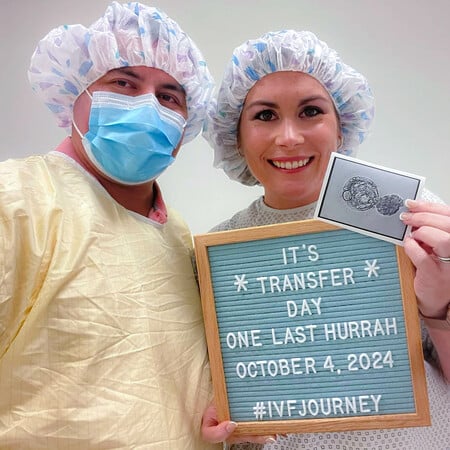
Ashley and David underwent IVF and over the next couple of years, she had three embryo transfers.
During that time, she needed multiple testing modalities and a surgery to improve her chances.
“Three transfers didn’t work, and we had one left,” she said. “We said this is it, the last chance, so we threw everything but the kitchen sink at it to make it work. And that last embryo stuck.”
Once pregnant, Ashley said she was doing well until she started leaking amniotic fluid at 28 weeks.
A strong start
“It was a Wednesday and I went to the hospital, knowing I wouldn’t be coming out without a baby,” she said. “I wasn’t in active labor, so they hoped I could get to 34 weeks. Just in case, they gave me steroid shots and magnesium to prevent complications.”
By that Saturday, however, Ashley began feeling mild contractions. They progressed throughout the day, until by that evening, Rhys Dunn was born at two pounds, 14 ounces.
“He came out kicking and screaming,” she laughed.
Rhys was born a fighter, but at 28 weeks, he needed to go to the neonatal intensive care unit (NICU) at James and Connie Maynard Children’s Hospital. This was challenging, especially when it was time for Ashley to discharge home.
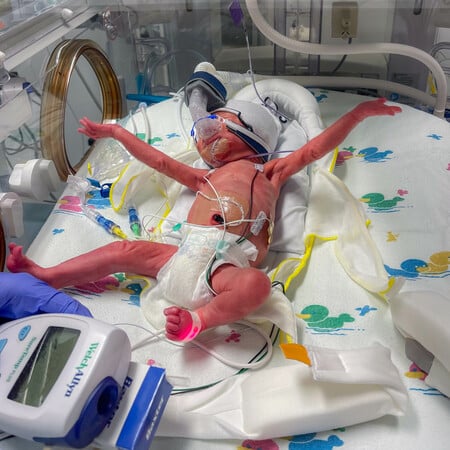
“It’s so hard to leave the hospital without your baby,” she said. “There was a lot of back and forth for us. But we felt at peace about him being there because we had a team that knew what it was doing and cared about us.”
There was even a camera set up so Ashley and David could check on Rhys anytime of the day or night, and the staff were available by phone if they wanted to call for an update on Rhys’s status.
“The nurses were so attentive; the doctors were great. A speech therapist helped him with his feeding. The care partners and the volunteers were helpful,” she said. “The team in labor and delivery were supportive and checked in on us. We felt Rhys was well taken care of, and when he came home, he was ready.”
After 71 days in the NICU, Rhys went home on Father’s Day weekend, and now, he is a happy one-year-old.
“He’s hit all his milestones and he’s very much a happy baby,” Ashley said. He’s sweet as pie, and he brings us so much joy. We have been so blessed.”
Ashley emphasized that she and her family are fortunate to live close to the Maynard Children’s Hospital and the high-quality care they provide.
“I was in a NICU support group and so many parents had to drive two or three hours to see their babies. How lucky we are to have a NICU in our backyard,” she said. “To have that quality of care so close is a luxury.”
The whole experience was a “whirlwind,” but Ashley said it’s been worth it.
“The life we have now wouldn’t be possible without the hospital and the people working there,” she said. “We are so thankful to each and every person.”
Share your story with us at go.ecuhealth.org/gratitude. Stories like these show the lasting impact of the Maynard Children’s Hospital.