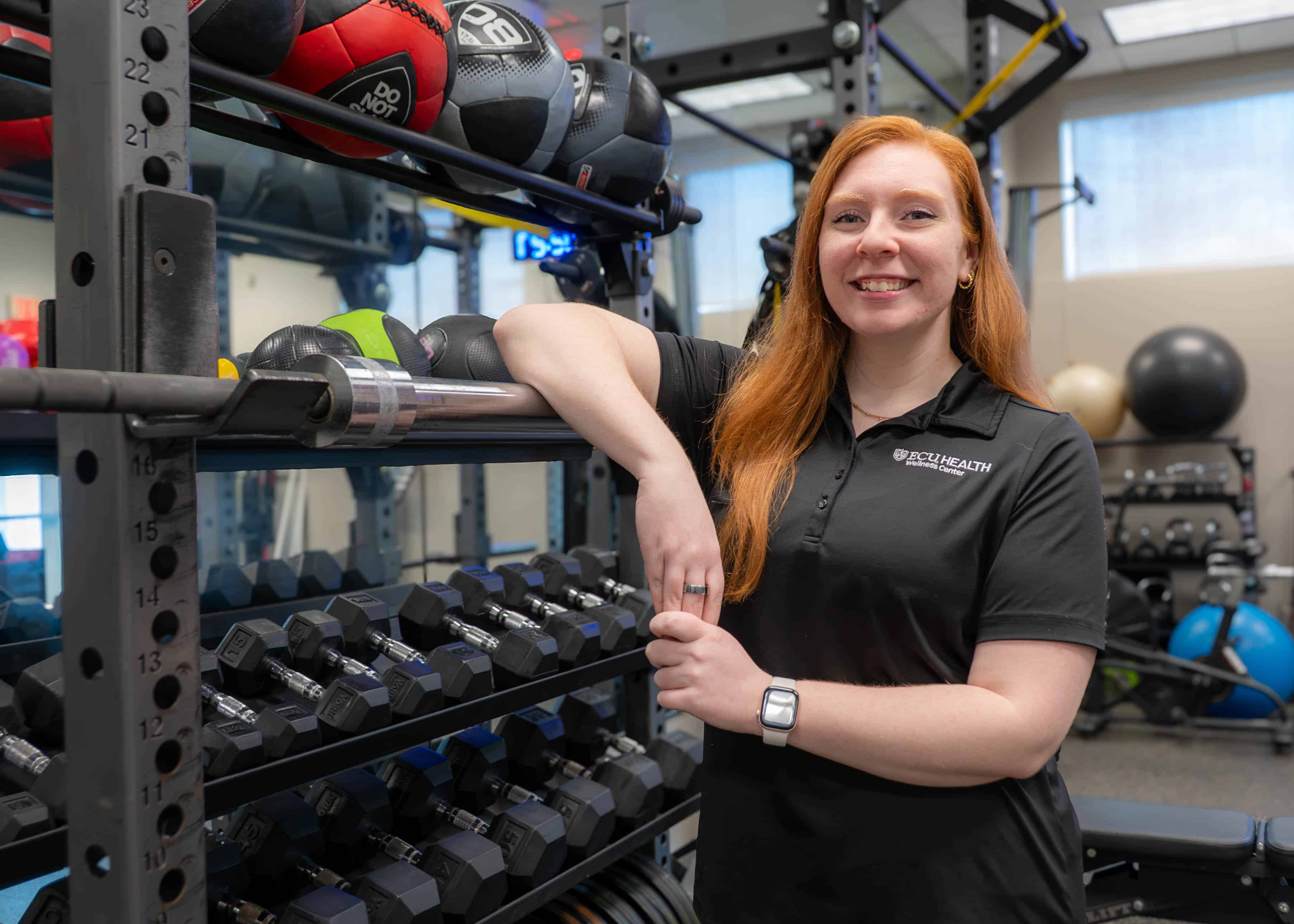
Cassandra Anderson, a lead exercise specialist at the ECU Health Wellness Center in Greenville, graduated from The State University of New York with her bachelor’s in exercise science and from Barton College with a master’s in exercise physiology. Her passion for medical fitness—something that stemmed from watching her own family members struggle with chronic illnesses and a lack of exercise resources—drove her to pursue this field.
“I have an expansive toolkit for multiple clinical populations and recently stepped into my role in overseeing all medical fitness programs,” Anderson said. “Part of what I love about my role is reaching out to a population that doesn’t have the ability to exercise, and we give them the opportunity to do it.”
When wellness became personal
Despite her clinical expertise and years of focusing on others’ physical health, Anderson found herself facing her own health challenges, and she’s grateful to the ECU Health providers who helped her diagnose and treat her condition.
“I always thought I was healthy. I stand for health and wellness and help others take care of themselves. I tell them to move well and often,” Anderson shared. “But after I was done with school and began working, I noticed some things that weren’t normal. Unexplained pain, migraines, issues with my skin—I wondered what was wrong with me.”
Anderson decided to see her primary physician who ran tests and didn’t see anything concerning aside from deficiencies in vitamins D and B. Her doctor prescribed supplements, but that didn’t help.
“Things got worse,” she said. “I had numbness and was tripping over my feet. I had brain fog, where I lost track of conversation, and muscle pain. I told my doctor and she sent me to ECU Health Neurology.”
A network of support
That’s where Anderson met Dr. Zilfah Younus, who scheduled her for an MRI.
“The MRI showed several lesions on my brain, and I began treatment for migraines because they were impacting my ability to work,” Anderson said. “Dr. Younus said I was young and didn’t have the textbook symptoms of multiple sclerosis (MS), but she suspected it.”
Multiple sclerosis causes the breakdown of myelin, the protective covering of nerves. This interrupts the communication between the brain and the rest of the body and eventually causes permanent damage of nerve fibers. There are different types of MS that present with different symptoms, and the cause is unknown, making diagnosis and treatment a challenge.
The treatment for her migraines helped, but one morning Anderson woke up and couldn’t feel her legs.
“They were numb. I could walk, but they felt like they weren’t my legs. I called Dr. Younus and she sent me for an MRI immediately,” Anderson said. “On the way home, she called me herself and said she was sure I had MS. She wanted me to go to the Emergency Department immediately.”
Anderson was admitted to the hospital and had a lumbar puncture to confirm the diagnosis.
“Dr. Younus called me later that day to confirm I’d gone to the ED and was admitted,” Anderson said.
“Not all doctors would do that. She said, ‘I know this is scary,’ and she explained what would happen while I was in the hospital.”
After three days in the hospital where she received steroid treatments, Anderson returned home with two more days of steroids and a referral to Dr. Susan Evans in neurology.
“She was amazing,” Anderson said. “She answered all my questions, showed me my scans, educated me on the disease and how she worked with her patients. She answered questions I asked in MyChart herself. She got me on my first treatment of Kesimpta, which is administered once a month at home and works with my busy schedule.”
With a diagnosis and plan in hand, Anderson said she felt taken care of and listened to. Then six months later, she experienced another setback.
“I woke up unable to see out of my left eye,” she said. “I called Dr. Evans and she sent me to Dr. Yen Nguyen at ECU Health Ophthalmology with an emergency appointment. She is a bubble of pure joy and it’s clear she loves what she does.”
Dr. Nguyen told Anderson that vision trouble was usually the first sign of MS and prescribed another steroid treatment. Dr. Evans worked Anderson into their busy schedule and even sat with her for her first steroid infusion.
“I was worried that my treatment wasn’t working anymore, but she explained that this didn’t necessarily mean the disease was progressing,” Anderson said. “With MS, small things can exacerbate symptoms. It was nice to have her there with me.”
Back to doing what she loves
For now, things have stabilized and Anderson said the care she’s received has made it so she can take care of others.
“I spend my days helping others move better and improve their overall wellness,” she said. “I could not continue doing the work I love without making my own wellness a priority, and the ECU Health network has helped me do exactly that. If I experience another flare or emergency, I know I am in good hands.”
Have a gratitude story of your own? Share your story with us at go.ecuhealth.org/grateful.