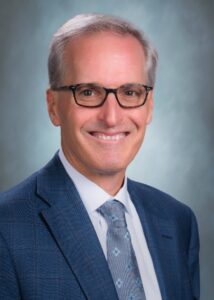
Dr. Michael Waldrum
Across rural America, healthcare is under attack. Pressure is mounting from looming federal cuts, including those to Medicaid, and increasingly aggressive behavior by large, for profit insurance companies. In eastern North Carolina, we are on the defensive, fighting every day to preserve even the most basic access to care, whether that means delivering a baby close to home or seeing a primary care provider.
Rural health systems are already stretched to the limit. We serve older, sicker, and poorer populations. We provide more uncompensated care with thinner margins and fewer alternatives than our urban counterparts. As proposals to reduce federal healthcare funding advance, pressure on rural hospitals continues to grow.
I recently shared these realities during my testimony before the U.S. House Committee on Ways & Means.
The hearing focused on affordability and access — two issues that will determine the future of rural healthcare. I shared ECU Health’s uniquely rural story, made possible only through the commitment of 15,000 team members who lead with purpose to deliver high quality care across our region.
I also shared a sobering truth: our organization faces a potential compounded loss of more than $1 billion over the next 10 years from Medicaid reductions included in H.R. 1.
Against this backdrop, we recently made the difficult decision to go out of network with UnitedHealthcare. This was not a tactic or a shortcut, but a last resort taken after years of imbalance and grounded in our responsibility to sustain access to care for communities that rely on us.
Rural hospitals operate on razor thin margins. We do not have billion dollar surpluses or large markets to subsidize rural care. Every dollar we earn supports patient care, our workforce, and maintaining access across a vast, rural region. When a health system with a large mix of Medicare and Medicaid patients is forced to accept an unsustainable contract by a dominant, for profit insurer, the consequences fall on patients: fewer clinicians, longer wait times, delayed services, and, in some cases, the real possibility of losing care altogether. This is the result if we allow healthcare to be treated as a profit-making tool by UnitedHealthcare, extracting value from our region and our state at the expense of rural communities.
Our approach to UnitedHealthcare has been in good faith, intended to reach an agreement that would preserve in-network access for our patients. Throughout this process, we have made every attempt to engage constructively and move negotiations forward. However, those efforts have been met with delays, limited responsiveness, and proposals that do not reflect the realities of providing care in our region.
When our attempts over the past year to reach a partnership with UnitedHealthcare proved unattainable, we faced a choice: accept a status quo that steadily erodes rural access or take a stand for our patients and communities. We chose to stand.
Our priority is supporting impacted patients and care teams through this transition. We continue to reach out directly to those affected to ensure they know what options are available to support the care they need.
At ECU Health, our obligation is clear. We exist to serve patients, families, and communities — not shareholders. Standing up for rural healthcare is not easy, and it sometimes requires saying no to powerful interests. Protecting access, supporting our workforce, and preserving the future of care in eastern North Carolina is not optional. It is our mission and it is worth fighting for.