Identical twins Richard Gregory, DMSc, PA-C, and Kenneth Gregory, DNP, FNP-C, have spent more than a decade working side by side in the ECU Health Edgecombe Hospital emergency department, where their collaboration is as intuitive as it is impactful.
Their journey to saving lives and treating patients in need of emergency care began long before they donned scrubs. From high school classrooms to military service in the U.S. Army, Richard and Kenneth have always moved through life together.
That shared experience laid the foundation for their parallel careers in health care—Richard as a physician assistant and Kenneth as a nurse practitioner. Their bond, forged in discipline and purpose, has shaped not only their clinical practice but also their academic pursuits.
In 2025, the Gregory brothers reached a milestone few siblings achieve together: earning their doctoral degrees. Richard graduated from A.T. Still University in Mesa, Arizona, with a Doctor of Medical Science, serving as vice president of his class. Kenneth earned his Doctor of Nursing Practice from East Carolina University in Greenville.
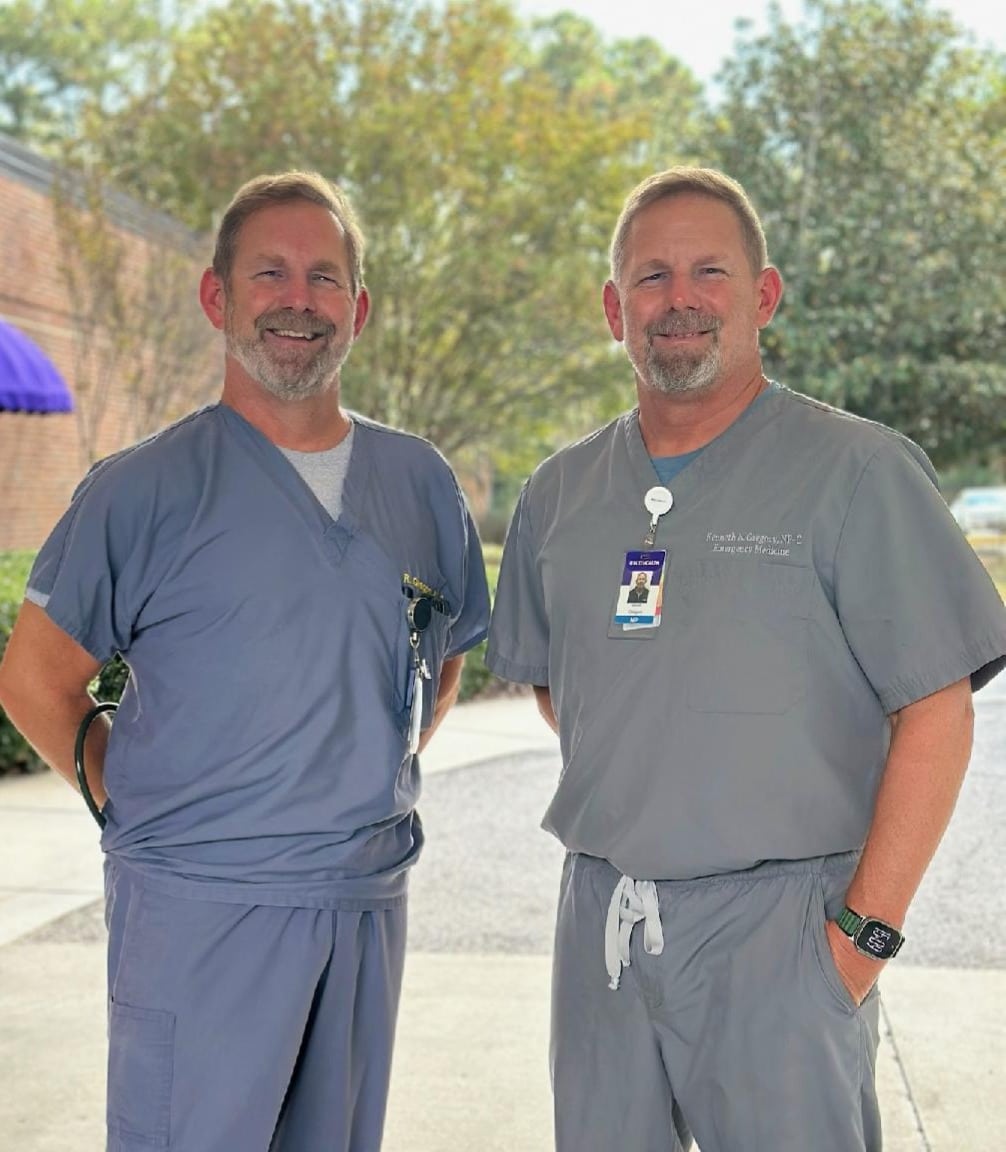
“Although our programs differed, Kenneth and I shared the same motivation to grow,” Richard said. “We held each other accountable, often staying up late to discuss coursework, research and strategies for balancing academics with full-time clinical responsibilities. There was an unspoken understanding: if one of us advanced, the other would not be far behind.”
“We’ve always moved through life together,” Kenneth shared. “So earning these degrees side-by-side just feels right.”
Their academic journey was not without challenges. Balancing full-time clinical responsibilities with demanding coursework required late nights, sacrifice and mutual support.
“We were each other’s personal accountability partners,” Kenneth said. “Our support focused less on reviewing content and more on making sure the other didn’t burn out.”
For Richard, the decision to pursue a DMSc was driven by a desire to expand his impact beyond direct patient care. With more than 25 years of experience, including a decade in family medicine and 15 years in emergency medicine, he saw advanced education as a way to strengthen leadership, education and evidence-based practice.
“Completing the DMSc program enabled me to contribute to meaningful improvements in patient outcomes and team performance,” Richard said.
As part of his doctoral research, Richard explored the use of low-dose ketamine (LDK) for managing acute pain in the adult population within the emergency department. With opioid stewardship in mind, his work aimed to educate providers through a decision tree that highlights an active protocol already in place across the ECU Health system.
“This research is about improving pain management while reducing reliance on opioids,” Richard said. “It’s a practical tool to support evidence-based decisions and enhance patient care.”
This addition reinforces Richard’s commitment to clinical innovation and aligns with the broader theme of systemic improvement. It also complements Kenneth’s work on opioid use disorder, as both brothers are tackling different aspects of the same public health challenge.
Kenneth’s DNP journey was inspired by a desire to implement systemic solutions in rural health care. His doctoral project focused on integrating transitional care for patients with opioid use disorder into the emergency department—a complex initiative requiring research, operational planning and administrative coordination.
“I wanted to go beyond treating immediate symptoms and focus on evidence-based, systemic change,” Kenneth says. “The DNP program trained me to lead, translate research into practice and serve as an innovative change agent.”
Now, with degrees in hand, the Gregory brothers are focused on using their expertise to advocate for rural health care needs at ECU Health Edgecombe Hospital and in eastern North Carolina—as well as champion the meaningful difference continuing education can make.
“Don’t pursue a degree just for the titles,” Kenneth said. “Pursue it to address a clinical or systemic problem that frustrates you. Having a clear purpose will keep you motivated when the coursework feels overwhelming.”
“Do it and don’t let fear hold you back,” Richard shared. “Advanced education challenges you to view health care form new perspectives and helps you to become not only a better clinician but also a stronger communicator, leader and advocate for patients and peers.”