Patients with heart failure in ECU Health’s Left Ventricular Assist Device (LVAD) program come from many walks of life. During an annual VADiversary celebration, they had a chance to share common ground as they reflected on how the treatment has given them back their voice, their mobility and their peace of mind.
ECU Health established its LVAD program in 2017. An LVAD is a highly specialized pump placed in patients with end stage heart failure. The battery-powered device has been shown to significantly improve heart function and relieve symptoms of heart failure, reduce hospitalizations and improve mortality rates in patients.
Dr. Matthew Colna, chief of Heart Failure and medical director of the Advanced Heart Failure and Mechanical Circulatory Support Program, said patients can live an average of five to six years longer with an LVAD.
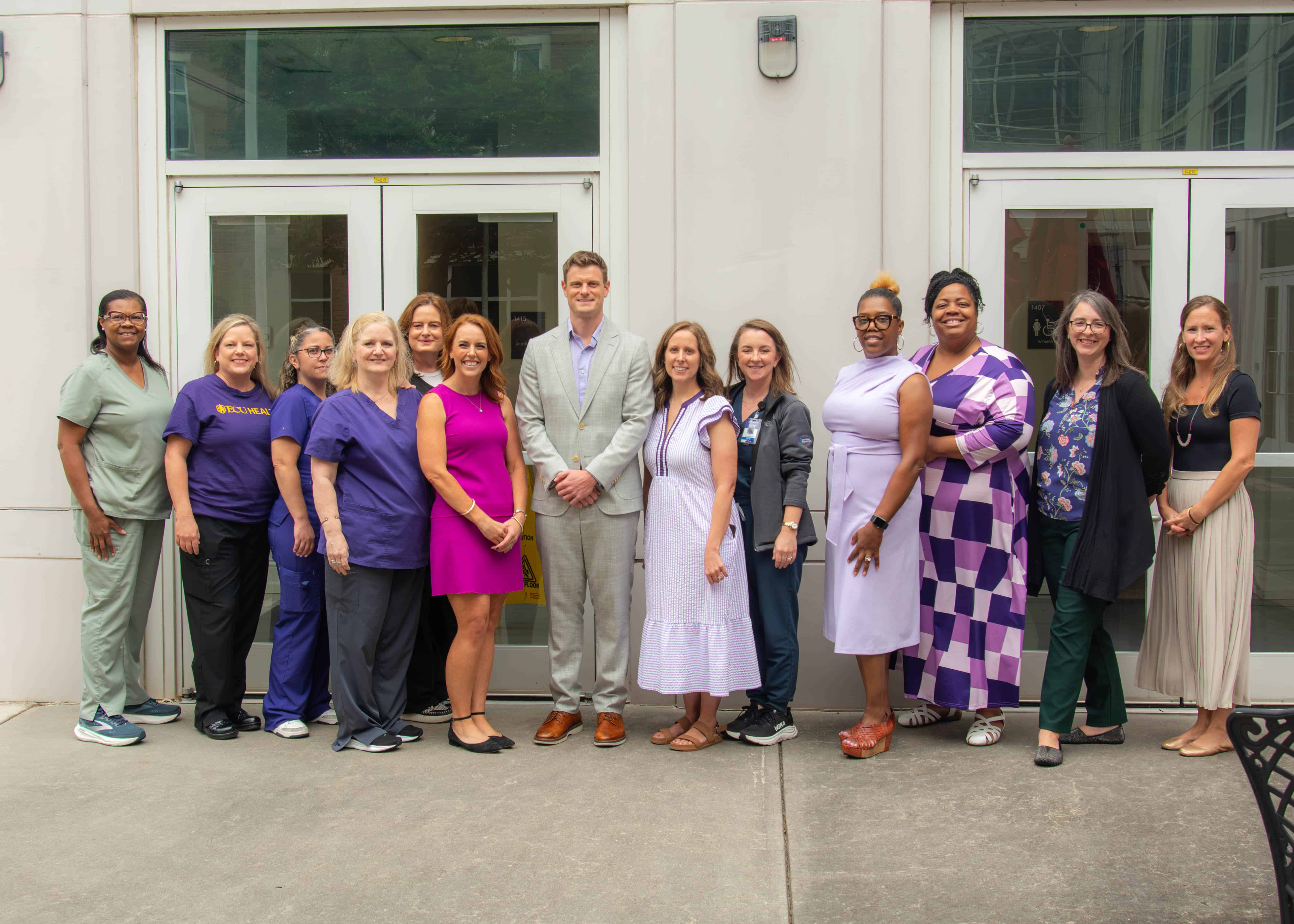
“Patients who receive an LVAD are among the sickest patients we treat,” Dr. Colna said. “The LVAD does not just improve their quality of life and extend their lifespan, it provides hope for those patients and their families. It lets them get back to doing what they love, and this VADiversary is our chance to celebrate their improved health and what we see as their second chance at life.”
The VADiversary celebration included a patient panel, where former patient Eddie Thompson told a gathered crowd how shortness of breath caused by heart failure stole his ability to sing at church.
“After one verse, I would be out of breath,” Thompson said. “I was frustrated.”
Thompson received an LVAD in 2023 and a heart transplant in 2024. Now he can sing without issue, and even showcased that talent for his providers, fellow patients and family from his spot on the panel with a two-minute hymn. He didn’t miss a beat, or skip a breath.
“I’m very happy to be able to do something I love again,” Thompson said.
Different paths, one community
ECU Health’s LVAD program currently supports 47 patients through a multidisciplinary team who are available to their patients 24 hours a day should they need consultation, or should an emergency arise. That leads to strong bonds and, for patients, even better peace of mind in their care.
Patients also regularly gather for monthly fellowship meetings featuring food, games and conversation. The meetings give them a place to know they are not alone in their experiences despite their seemingly unique circumstances.
Theresa Lynn of Greenville was diagnosed with heart failure in 2015. At first, she did not let the diagnosis slow her down and continued driving for rideshares and taking care of her family. In 2019, she took her daughter to give birth at ECU Health Medical Center.
“The whole time, I was in pain,” Lynn said. “My daughter told the nurse I was a heart patient. They took my blood pressure, it was sky high, and they took me to the emergency department.”
Lynn found out she had been having a “massive” heart attack the entire day. A cardiologist told her about LVAD and that she would have to stay inpatient due to her condition. She agreed to the procedure, a decision she said has shaped her life in more ways than one. She is once again on the move, traveling domestically and abroad to see old friends and experience new places.
Norleen Edwards suffered a heart attack in 2021, said that team has helped her significantly with the worry she felt about the device and heart failure in general.
“They always were on my side, even before I got the LVAD,” Edwards said. “I had a lot of anxiety, they helped talk me through it. These guys, oh my God, they’re the best team ever.”
The meetings are also a place to share how patients and their families have an impact on the greater community in eastern North Carolina. Terry Woolard of Washington, an Operation Desert Storm veteran and cancer survivor, was working as a nurse in West Virginia when a cardiac event landed him in a Pittsburgh, Pennsylvania hospital. That’s where he first found out he had heart failure.
Woolard continued various treatments for the condition until 2016, when he was introduced to LVAD through the team at ECU Health. He has had his LVAD the longest of any patient being treated by ECU Health’s multidisciplinary team, and has embraced a role as a teacher along with that of an LVAD patient. In his free time he allows nursing and emergency services students at community colleges to listen to his heart to know what to expect should they need to respond to an incident involving an LVAD patient.
“My heart does not sound the same as yours,” Woolard said. “I want them to know what they are getting into, know that there are different ways they need to treat patients like me. It’s my way of giving back.”
Lynn, and other patients, are sometimes asked to speak with prospective LVAD patients who are concerned about the procedure. She said the opportunity to share firsthand how the device has helped improve her quality of life has become something of a calling.
“I feel like that’s why God brought me back,” Lynn said. “I knew I had a purpose, and now that purpose is to be an advocate for LVAD and heart failure patients. I love what I do.”
Dean Sauls spent over 40 years as an educator in Wayne County. In May of 2024, he went on a Disney trip to Florida with his wife, in-laws and nine children. He felt out of breath, constantly having to cut his day at the park short to go back and rest at the group’s hotel.
At a routine appointment in July of that year, a physician told Sauls he might only live another year without some kind of intervention. Three weeks later, he had an LVAD procedure.
“I started rehab and I was on the walker, just zigzagging and counting my steps,” Sauls said. “When I got home, I’d walk around the yard when the weather wasn’t too hot. Just anything to stay in shape.
“I really understand eastern North Carolina and I appreciate what the medical center does for this community,” he continued. “I look forward to this reunion; it’s a great thing to be a part of.”
Critical care close to home
Timothy Bizzell of Beulaville has been living with his LVAD for five years. In 2021, he fainted at home and regained consciousness face down on the floor as his wife called for an ambulance. He was transported for care at ECU Health Medical Centera cardiovascular physician told him his heart had stopped.
“He asked me, do I want to live or do I want to stay like I was?” Bizzell said. “I want to live. He told me about this program, the LVAD program.”
In Duplin County, Bizzell said his mind is at ease knowing that there are people and treatments that can support his condition close to home. That’s important in rural areas where, according to a 2024 report from the North Carolina Department of Health and Human Services rates of heart disease are higher than urban sectors of the state due in part to limited access to healthy food, transportation and access to care.
According to the most recent Center for Disease Control data on local heart failure mortality from 2010-19, the 29 counties where ECU Health provides care saw an average of 25.5 deaths from heart failure per 100,000 people aged 35-64, higher than the statewide average of 21.1 deaths from heart failure per 100,000 people aged 35-64 in that same period of time.
“It gives me a lot of hope, knowing this type of team and this technology is just down the road,” Bizzell said. “I’m grateful for the team. I know all I have to do is call. It’s not going around the corner, it’s right there.”
Before his LVAD, Bizzell said he visited the hospital twice a month due to complications from heart failure. Ever since getting the device, he said he only goes to the doctor for scheduled appointments.
“It could have been the other way, but I have another chance,” Bizzell said. “I thank God for the LVAD team. They gave me that second chance, they gave me quality of life.”
Dr. Colna agreed that access to a specialized tool like LVAD plays a significant role in improving cardiovascular health outcomes in eastern North Carolina.
“It’s of the utmost importance that ECU Health can provide these patients the therapy they need in their own community,” Dr. Colna said. “Otherwise, they would have to travel long and far for treatment. We can offer it in their own backyard.”