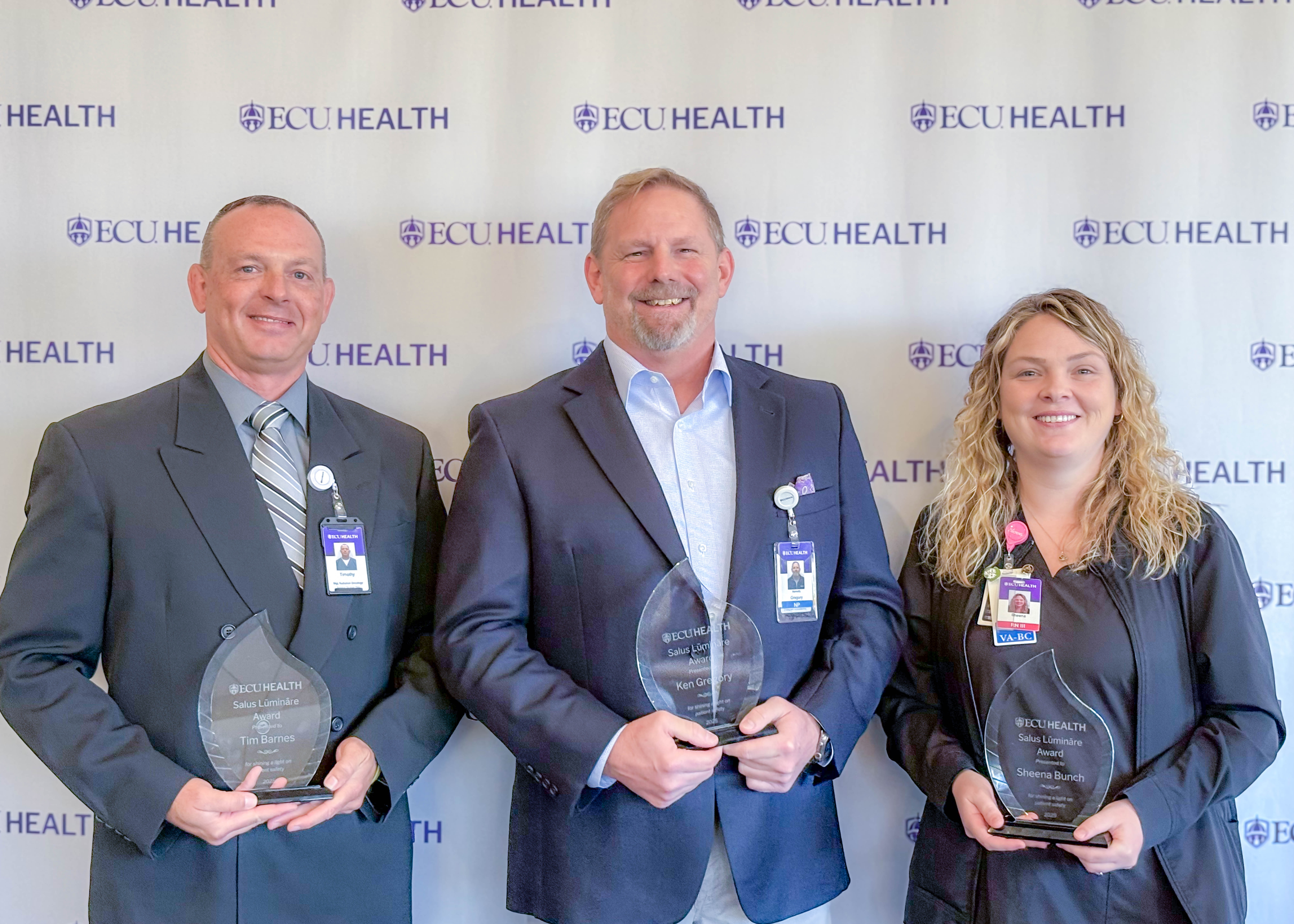
The Salus Luminare award honors team members who “shine the light on safety,” and it is a part of ECU Health’s mission to create safe working environments, both physically and psychologically. This year, Tim Barnes, clinical manager of ECU Health Medical Center’s Radiation Oncology, Kenneth Gregory, nurse practitioner at ECU Health Edgecombe Hospital and Sheena Bunch, staff nurse III with Radiology at ECU Health Beaufort Hospital, were recognized during the Nov. 18 ECU Health and ECU Health Medical Center Quality Improvement Committee of the Board meeting as award recipients.
Sheena Bunch
In her highly specialized role of performing vascular access procedures throughout ECU Health Beaufort Hospital, Sheena Bunch supports multiple departments and providers while keeping safety front of mind.
“I’m one of the few nurses in the system trained to insert internal jugular central venous lines, which has allowed me to play a big part in improving line care and patient safety,” Bunch said.
Central line-associated bloodstream infections (CLABSIs) are serious and can lead to critical complications, including septic shock or death.
 “Early in my career,” Bunch shared, “I saw how easily small oversights could lead to complications for patients and that made an impression on me. I’ve personally experienced loss and hardship that remind me how fragile life can be and how every decision matters.”
To help avoid these complications, Bunch began auditing all charts of patients with central lines to make sure the correct maintenance and care orders were entered. When she noticed some inconsistencies, she took the initiative to create a central line maintenance and care order set for nurses to follow.
“This helped standardize care, improve communication and reduce the risk of central line-associated infections. I’m passionate about creating systems and processes that prevent harm before it happens,” she said. “It’s not just about following policy; it’s about protecting someone’s loved one and giving every patient the safest chance at recovery.”
Bunch said she strives to lead by example to promote safe practices.
“I share the ‘why’ behind everything we do and explain how something like an updated order set or quick double-check can make a real difference in patient outcomes,” she said. “I also make a point to celebrate when someone speaks up or catches something that prevents a potential issue. When people feel empowered instead of criticized, they are more invested in safety.”
Winning the Salus Luminare award was an honor, Bunch said, because it recognizes the heart of nursing.
“So much of the work we do in safety goes unseen. It’s about the details and the quiet improvements that prevent harm. This award tells me that the effort to build safer systems truly matters and ECU Health values nurses to take the initiative to make those changes.”
“It’s been rewarding to see how this change has made things safer for our patients and easier for our team members caring for them,” Bunch went on. “I’m proud to work for an organization that values patient safety and empowers nurses to take initiative. I’ve been fortunate to be a part of a team that supports innovation and trusts nurses to make meaningful changes.”
Kenneth Gregory
While pursuing his doctorate of nursing practice (DNP) at East Carolina University (ECU), Kenneth Gregory used an ongoing problem he observed at work as the foundation of his doctoral project.
“I observed patients presenting to the emergency department (ED) with opioid overdose or withdrawal and realized we didn’t have a mechanism to facilitate a safe transition for continued outpatient treatment,” he shared.
 Gregory’s DNP project required he focus on a gap in health care, based on what literature says providers should do versus what was actually happening.
“I wanted to help an overlooked population and make a positive change. There is a huge opioid problem in this state,” Gregory said. “The hope was we could decompress the ED and save a life or two.”
To solve this problem, Gregory established a process that provided these patients with access to outpatient care.
“We now have a direct path from the ED in Tarboro to Freedom Hill Community Health Center where there’s an outpatient opioid care facility,” Gregory said. “Freedom Hill is close by and uses a sliding scale for costs, making it more accessible.”
To implement this new process, Gregory said it required a lot of communication with the ED team, including staff meetings with education on the new process to ensure everyone was on board. Once they caught on, Gregory said it was gratifying to see the team follow through on the process.
“Nurses would come and say, ‘Hey I have this patient who might benefit from this.’ They were taking notice of how they could help, when previously there was uncertainty on how to help these patients,” Gregory said. “You could feel the groundswell of empowerment when the nurses had a way to do something for this patient population.”
Gregory said that thinking through these kinds of quality and safety concerns is just one part of being a health care provider.
“Safety improves the quality of care we provide. I was in the army for six years, and there was this fundamental thought: always try to improve your situation,” Gregory said. “That’s how I think about my work here, and safety is a part of that.”
While Gregory said it’s a great legacy to have found a way to support an underserved population, he attributes the program’s success to his team.
“We don’t work in silos and as a provider, you have to wrap your arms around everyone who works with you,” Gregory said.
Tim Barnes
Being a registered technologist in Radiation Therapy was not Tim Barnes’ first career.
“I started off in law enforcement in Wilson,” Tim shared. “I was a homicide detective for seven years and a patrol officer three years before that.”
However, Tim said a lot of his work in law enforcement informs the work he does today.
“It’s a big jump, but there is a lot of overlap,” he said. “They both revolve around doing things safely and paying attention to details. Radiation therapy is high risk and requires a great deal of care.”
One of those details was an observation Tim made about weekend emergency radiation treatments.
“We have a rotational on-call schedule for emergency weekend treatments, and there was just one therapist on call for a weekend,” he said. “During weekdays, however, the normal process involves at least two therapists for each treatment because there are a lot of steps.”
With such complexity, Tim wondered – why weren’t they using two therapists on weekends?
“This didn’t make sense to me, and when I became the lead therapist, I made a policy change stipulating that weekend emergency treatments required two on-call therapists, as well as a physicist.”
Tim also implemented the Good Catch program, a near-miss safety reporting system.
“I wrote an article for the American Society of Radiologic Technologists (ASRT) magazine about incident reports,” he said. “I attended a presentation by Larry Marks, the Radiation Oncology chair at The University of North Carolina Chapel Hill. They were developing a proactive reporting system known as the ‘Good Catch’ system, designed to learn from near misses and share how incidents were prevented. I wanted to implement a program like that here at our hospital.”
This innovation in safety reporting encourages team members to talk about what they do to prevent safety incidents from happening on a daily basis. Tim met with his team to explain the new reporting system but he said it took three years to get the team fully entrenched.
“I had to show them it was a way to make the department safer, not a tattletale system,” he said. “It took communication, and not just one day. Every month I met with the team to go through every single Good Catch, so they knew each one was being seen and discussed. Once it caught on and our department and the doctors were engaged, it became the culture of our department.”
Now, the program is system-wide, but Tim doesn’t want to stop there.
“I want to spread this beyond the system, so I’ve shared this at the National Commission on Quality Reporting (NCOG) in Charlotte for quality and safety improvement for radiation oncology clinics. With similar programs at other clinics, we can learn from each other.”
Tim said he’s humbled to win the Salus Luminare award.
“I didn’t go into this for me,” he said. “I did it because I saw a way we could treat patients safer. But I didn’t do it alone. I was at the forefront of the idea and introduced it to the department, but it took the team to get on board to make it happen. I share this award with them.”
A culture of safety and excellence
While three team members were named winners of the Salus Luminare aware, 56 team members were nominated, demonstrating ECU Health’s ongoing prioritization, implementation and recognition of safe patient practices.