Decades before Pitt County Memorial Hospital opened, local doctors risked their livelihood so their neighbors could have a hospital of their own. On Nov. 13, 2026, that same persistence and commitment to care across generations of health system, university and community leaders filled the room where ECU Health Medical Center celebrated its 75th anniversary.
Pitt County Memorial Hospital began in 1951 as a 120-bed hospital to provide care close to home. Now, ECU Health Medical Center stands as the flagship academic medical center anchoring care across nine community hospitals which serve 1.4 million people across 29 counties in eastern North Carolina. With that comes a $4.5 billion economic stimulus for the region, contributing to the vitality of communities where people live and work in one of the fastest growing areas of North Carolina.
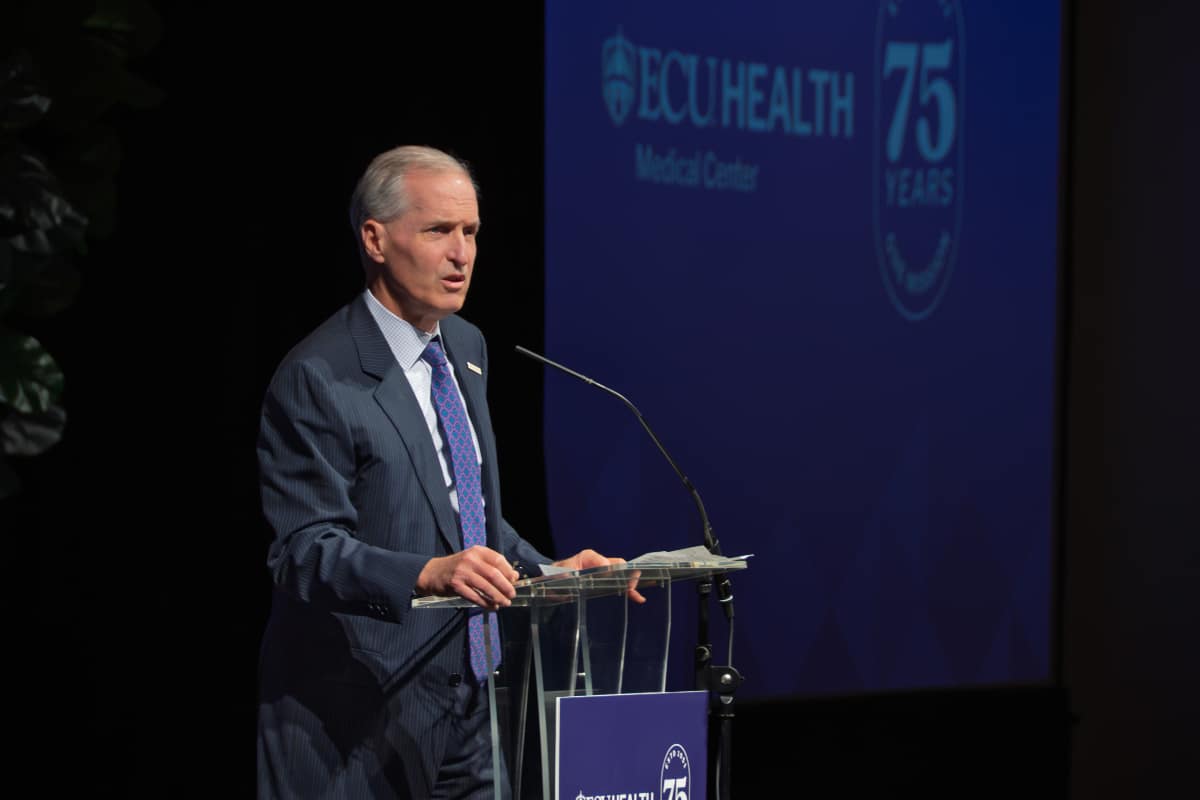
“Everybody in this room helped to create ECU Health’s model for rural health care and has helped deliver on our mission to improve the health and well-being of eastern North Carolina” said Dr. Michael Waldrum, CEO of ECU Health and dean of the Brody School of Medicine at East Carolina University. “That means giving people economic opportunity, educating them, giving them hope and providing care.
“Every day we look forward, but we are reminded of our responsibility to do things the right way. It is measured in lives and measured in hope for the people who we serve, and it is important that we all remember the values that created this over 75 years, the profound leadership to engage in important issues, deliberate on those issues and chart the future.”
Jay Briley, president, ECU Health Medical Center, in detailing the medical center’s history, said that 75 years of growth are the product of hard work and an understanding that communities, no matter how small, have the right to health care.
“Our county and community leaders, our board members past and present, as well as the thousands of team members at the hospital right now caring for family members, neighbors and friends are a central part of the legacy we are celebrating,” Briley said. “Like the people who established that nonprofit hospital decades ago through private organizations and local government, we believe those families, neighbors and even strangers deserve care.”
Even before that, the concept of ECU Health was conceived in 1901, when Dr. Charles Laughinghouse started the work to establish a community hospital in Pitt County to provide inpatient care. Briley called it a simple idea, but no simple task. After Dr. Laughinghouse returned from serving his country in World War I in 1923, he resumed practicing medicine and working to establish the community hospital. When community support fell $85,000 short of the need, Drs. Laughinghouse, Karl Pace, William I. Wooten and E.T. Dickerson took out money against their life insurance policies or additional mortgages on their homes to close that gap.
“That is the foundation we stand on,” Briley said. “This hospital, born of the one that came before, was a community decision long before it was a building.”
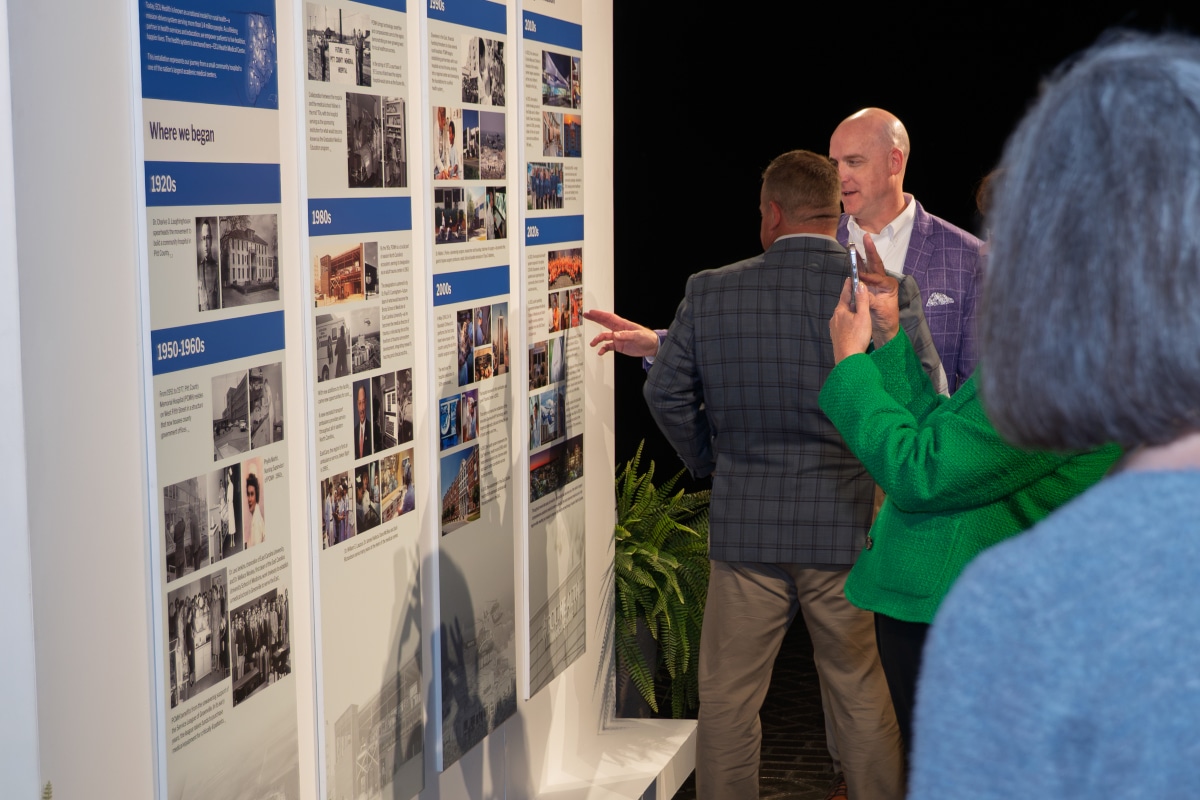
That history was honored at the anniversary banquet with an historic gallery depicting milestone moments like becoming the teaching hospital for the Brody School of Medicine, establishing the EastCare transport service, the signing of a joint operating agreement with ECU in 2023 and development of such critical infrastructure as the James and Connie Maynard Children’s Hospital, Eddie and Jo Allison Smith Cancer Tower and East Carolina Heart Institute. The historic gallery will go on to adorn the lobby of ECU Health Medical Center in further commemoration.
Those milestones were also celebrated through a video offering perspective from the very giants on whose shoulders ECU Health now stands — physicians, volunteers, administrators and board members whose commitment to improving the health and well-being of eastern North Carolina laid the bedrock to ECU Health becoming a national model for rural health care.
But, like all history, there was adversity. Like other rural hospitals across the nation, ECU Health faced tremendous financial pressure to remain afloat. Efforts to maintain and expand services amid the turbulence were led in part by Dave McRae, who served as the health system’s president from 1989 until 1999. Before his tenure as president, McRae was among the leaders who helped move the hospital from its former location on West Fifth Street, now the Pitt County office complex, to its current home on Stantonsburg Road in 1977.
“On the day it moved we all wore our jeans so we could help get people moved,” McRae recalled. “Back then we didn’t have enough money to buy new furnishings for the new hospital, so as we moved the patients we had to tell them ‘By the way, don’t touch the furniture when you get back in bed, it has to dry. It’s been painted while you were being moved.’ That’s a true story.”
Furnishings were not the only financial obstacles faced by the medical center, McRae said. At one point, he was informed there was no money left to pay the bills despite the continuing flow of patients. Still, the hospital persisted.
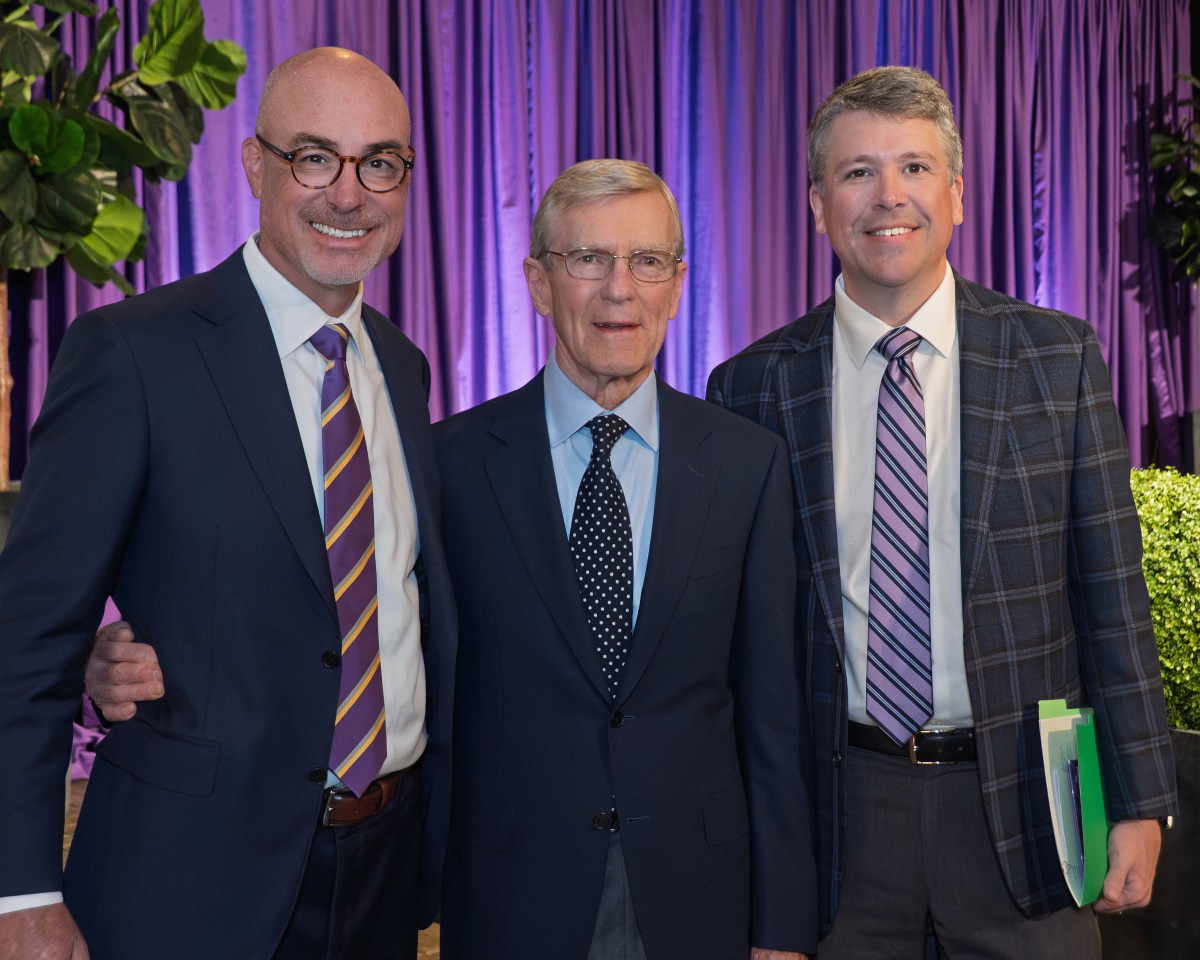
“We found a way to survive and get through for a while, but it taught me a hard lesson,” McRae said. “We were careful from that time on to always be sure that we managed our finances. We didn’t want to see our hospital face what happened in some other fine institutions, where rating agencies placed somebody in there to keep an eye on them. Our team, the board, leaders, got us to the point of having a AA bond rating and we never lost it. We got put on a watchlist occasionally, but sure enough every time, even when we grew to 300, 400, all the way to almost 900 beds, we kept our rating.”
Challenges do not just disappear. Neither do the people who rise to meet them. Brian Floyd, chief operating officer and president, ECU Health, pointed out that even amid the celebration, back at the medical center there were EastCare helicopters landing with patients in serious need, clinicians rushing to medical codes and nurses writing happy birthday messages to newborn babies, some who might spend their first days in the Neonatal Intensive Care Unit.
“It is remarkable to think that from that little red brick building on Fifth Street to Pitt County Memorial Hospital that we would be describing an organization today that is among the 20 largest hospitals in the United States,” Floyd said. “That size is not a testament to our aspirations; it is a testament to the disproportionate needs of eastern North Carolina. Inside those walls technology has evolved, skills have developed and each stage of our evolution is chasing the next most pressing need of our communities.
“The story is continuing, because despite the headwinds of rural health care the people here are resilient. We will continue to pursue this mission, and we will overcome the next set of challenges. While we are talking about what has been built here, this sacred thing that has saved countless lives and given so many people a path to making a difference, I hope we remember that the one thing that has never and will never change is that people still care more here.”