Washington, D.C. – Dr. Michael Waldrum, a critical care physician and chief executive officer of ECU Health, testified today before the U.S. House Committee on Ways and Means, urging federal policymakers to pursue targeted solutions to address rising health care costs and protect access to care for America’s rural communities.
During his testimony, Dr. Waldrum emphasized that rural health systems operate under fundamentally different conditions than their urban counterparts and stressed that “one size fits all” policies risk disproportionately harming rural patients and providers.
“I am deeply appreciative of the opportunity to testify before the U.S. House Committee on Ways and Means to highlight the important, mission-driven work we do here at ECU Health, as well as the challenges we face as a rural safety net health system,” said Dr. Waldrum. “Access to affordable, high quality care should not depend on where someone lives. The challenges facing rural health systems are real and structural, and they require solutions that recognize the unique realities of rural communities.”
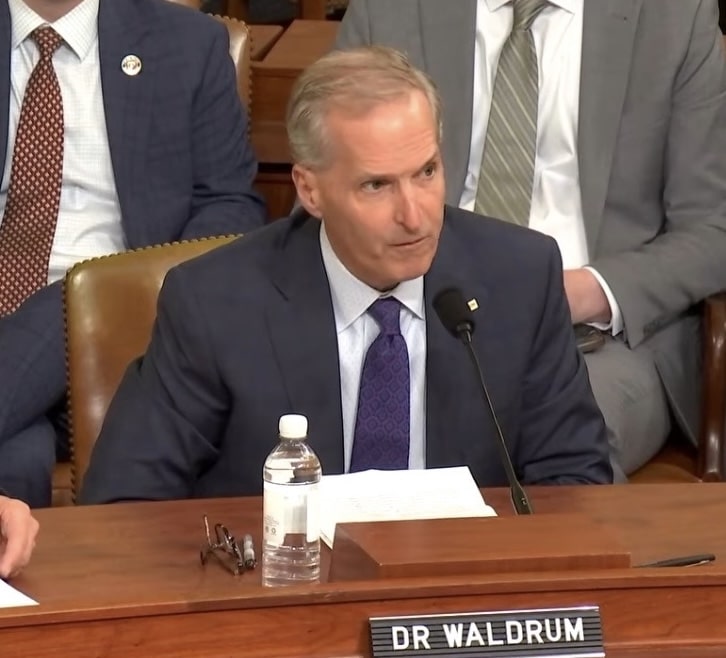
As the leader of a nonprofit health system serving more than 1.4 million people across a 29 county region in eastern North Carolina, Dr. Waldrum shared firsthand insights into the pressures facing rural providers, including older and sicker patient populations, limited population growth, workforce shortages and care delivery across vast geographic areas. He noted that if eastern North Carolina were its own state, it would rank among the poorest and sickest in the nation — realities that, when combined with regulatory and financial pressures, have contributed to rural hospital closures and increasing consolidation across the health care landscape.
At ECU Health, those ongoing pressures have required a deliberate, community driven approach to sustaining access. The system operates a regional hub and spoke model in which its academic medical center supports eight hospitals and more than 1,200 providers throughout rural communities — not in pursuit of scale, Dr. Waldrum said, but out of necessity.
“When profit driven systems exit rural markets, nonprofit health systems like ECU Health are left to serve as the safety net,” Dr. Waldrum told committee members. “Thoughtful policy intervention is needed to support rural safety net providers like ECU Health in order to preserve access, improve outcomes and lower costs for rural patients.”
Drawing on experience training and practicing at nationally recognized health care institutions, Dr. Waldrum contrasted the abundant resources available in urban markets with the consequences he has witnessed when even basic access to care erodes in rural areas.
“These dynamics are not theoretical — they are playing out every day in rural communities across America,” he said.
ECU Health is actively transforming its rural academic regional system of care to lower costs, sustain essential services and support the economic vitality of eastern North Carolina. While progress has been made, Dr. Waldrum stressed that meaningful, lasting solutions will require partnerships with federal policymakers.
As Congress weighs health care affordability and payment policy, he encouraged committee members to design approaches that account for the needs of the nation’s 66 million rural residents and avoid inadvertently disadvantaging communities already facing limited access.
“We recognize the immense challenge before Congress,” Dr. Waldrum said. “ECU Health stands ready to work with policymakers on solutions that strengthen access and affordability and ensure rural communities are not left behind.”