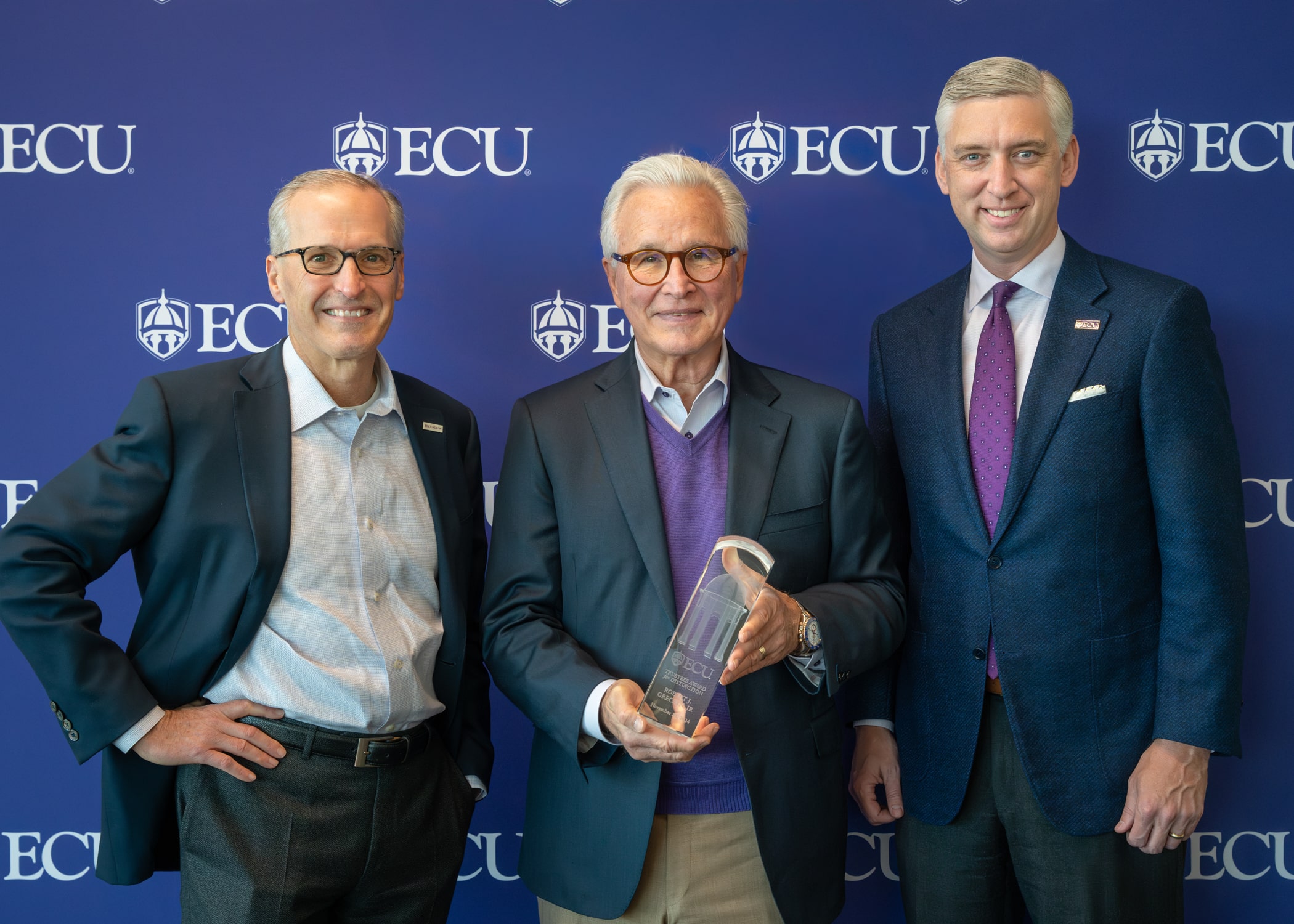
Robert J. Greczyn, Jr., chair, ECU Health Board of Directors, recently received the 2024 Trustees Award for Distinction from the East Carolina University Board of Trustees in honor of his extraordinary leadership and service. This prestigious award recognizes individuals who embody excellence, innovation, and an unwavering commitment to advancing ECU’s mission of student success, public service, and regional transformation.
“I am deeply honored to receive the 2024 Trustees Award for Distinction,” said Greczyn. “East Carolina University and ECU Health have been central to my journey of service, and I am grateful to have played a part in advancing the collective mission to improve lives across our region.”
The Trustees Award for Distinction is reserved for leaders who inspire, influence and motivate others toward achieving shared goals. Honorees demonstrate a profound dedication to ECU’s strategic vision through championing partnerships, fostering philanthropy, and promoting public service—all while exemplifying strong character and professionalism.
Greczyn’s devotion to ECU runs deep. As a former member and chair of the ECU Board of Trustees from 2003 to 2011, Greczyn has continuously worked to elevate the university. Currently, he serves as chair of the ECU Health Board of Directors, where his extensive health care experience has been pivotal in integrating the health system with the Brody School of Medicine.
“Bob’s passion for serving the underserved and addressing complex health care challenges has been a guiding light for ECU Health,” said Dr. Michael Waldrum, chief executive officer of ECU Health and dean of the Brody School of Medicine at East Carolina University. “Through his leadership, the organization has stayed true to its mission-driven focus on improving the health and well-being across eastern North Carolina.”
Greczyn has been a prominent leader in North Carolina’s health care landscape for over three decades. Professionally, he served as the president and CEO of Blue Cross and Blue Shield of North Carolina from 2000 to 2010.
He also served as president and CEO of Healthsource Health Plans Inc. Greczyn also established a Rural Health Center in Anson County. His expertise running both not-for-profit and for-profit entities is supported by a leadership style that emphasizes enterprise risk, compliance, ethics and governance standards.
“As a member of our board, Bob has always advocated for patients, their families, team members, students, educators and especially those in underserved communities who struggle to gain access high-quality care,” said Dr. Waldrum. “His focus has always been on how we can make the greatest impact for our region. I am grateful to have the privilege to serve alongside so many mission-driven individuals like Bob who dedicate themselves to advancing this beautiful part of our state.”
Greczyn’s influence extends far beyond professional achievements; his commitment to serving underserved communities, championing collaboration, and driving positive change underscores his dedication to the mission of ECU. Greczyn’s recognition through the Trustees Award for Distinction is a testament to his enduring impact on ECU, ECU Health and the communities we serve.
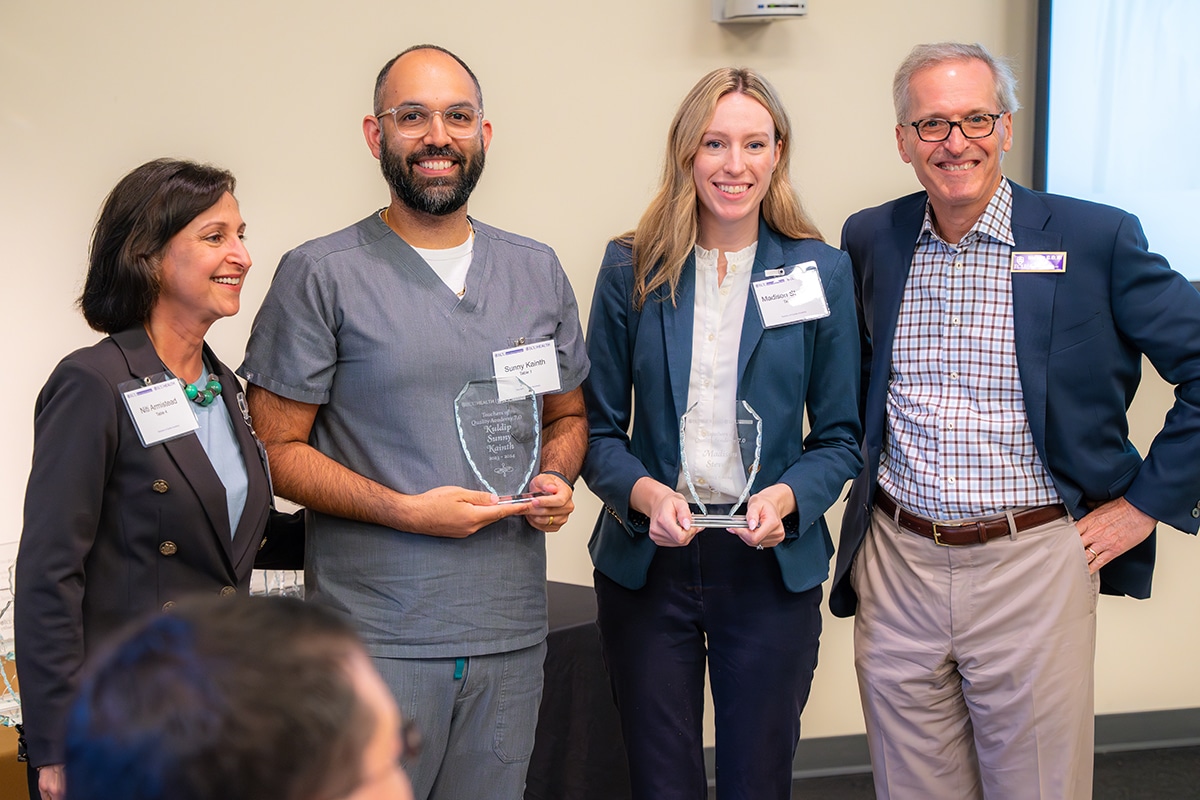
There were plenty of smiles and handshakes at the Teachers of Quality Academy (TQA) 7.0 Recognition Ceremony on Sept. 30, as 37 graduates from the most recent TQA cohort celebrated successful completion of the program alongside ECU Health and Brody School of Medicine leaders.
TQA is a professional development program for health care leaders designed to fundamentally change care delivery through a curriculum focused on building knowledge and skills in Health Systems Science which comprehensively explores how health care is delivered. Participants engage in advanced learning in quality improvement, patient safety and team leadership, develop improvement projects to apply these skills across the health system, teach others in their environment about these concepts and evaluate the outcomes of improvement interventions. Leading by example, TQA participants promote a culture of quality and safety across the enterprise.
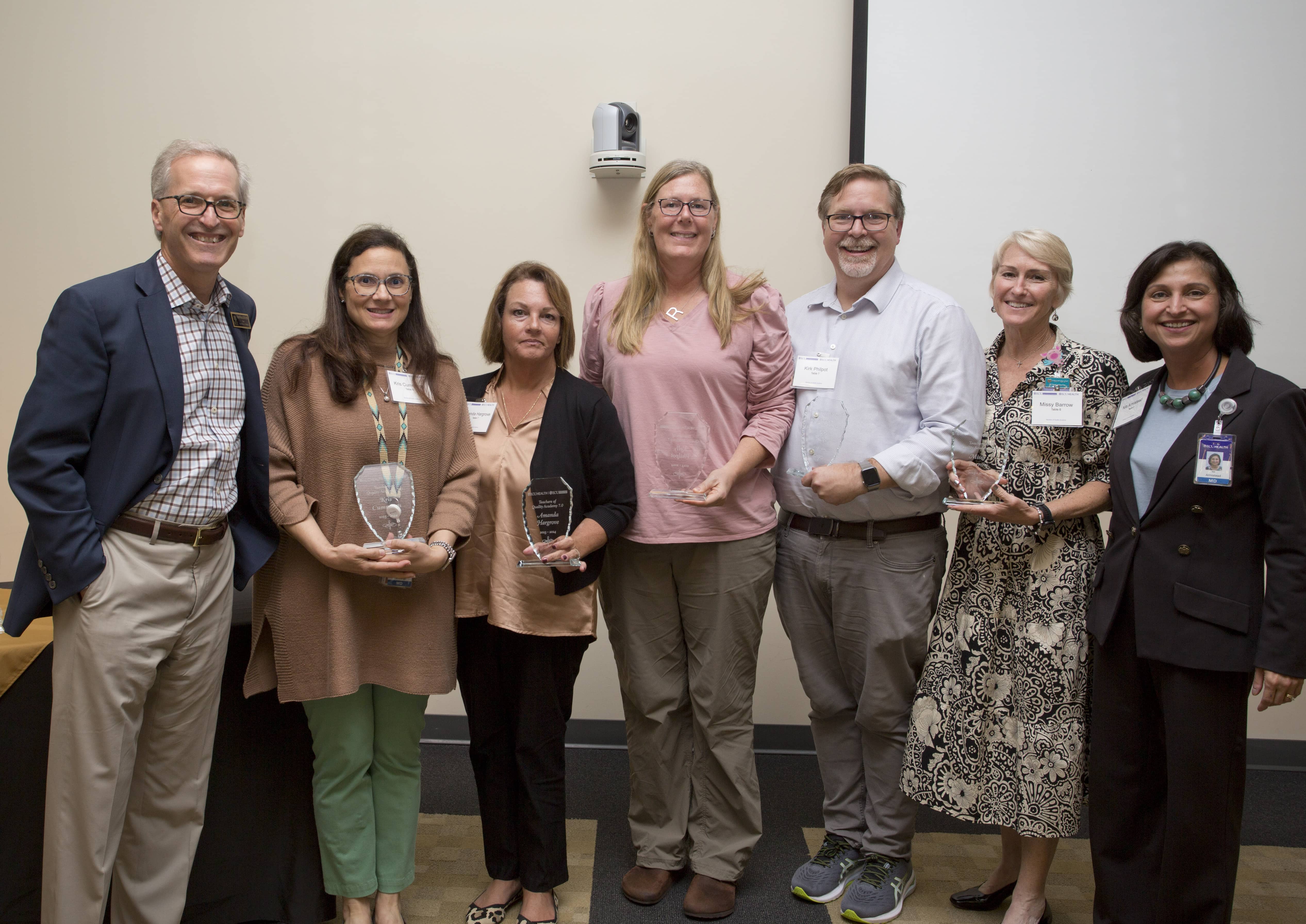
This year’s program graduates came from multiple areas of expertise and locations, including ECU Health Physicians, ECU Health Medical Center, ECU Health North Hospital, ECU Health Chowan Hospital and Contentnea Health. Additionally, the cohort includes participants from ECU Health’s Rural Family Medicine Residency Program, ECU Health’s Administrative Fellowship Program and the MedServ Fellowship Program.
“As an academic health care organization, it’s incredibly gratifying to see educational programming like TQA woven into ECU Health and Brody’s culture of quality improvement,” said Dr. Michael Waldrum, ECU Health CEO and dean of Brody. “You can see and feel the pride that people take in improving quality, and that has real tangible impacts on patients who can experience better health and wellness as a result. This cohort and these graduates are an example of our quality improvement culture which TQA has helped build.”
According to Dr. Jennifer Sutter, TQA physician director, the diverse, multidisciplinary class represented the ultimate goal of the program: to further knowledge and instill principles that help health care professionals across eastern North Carolina improve quality on behalf of the patients they serve.
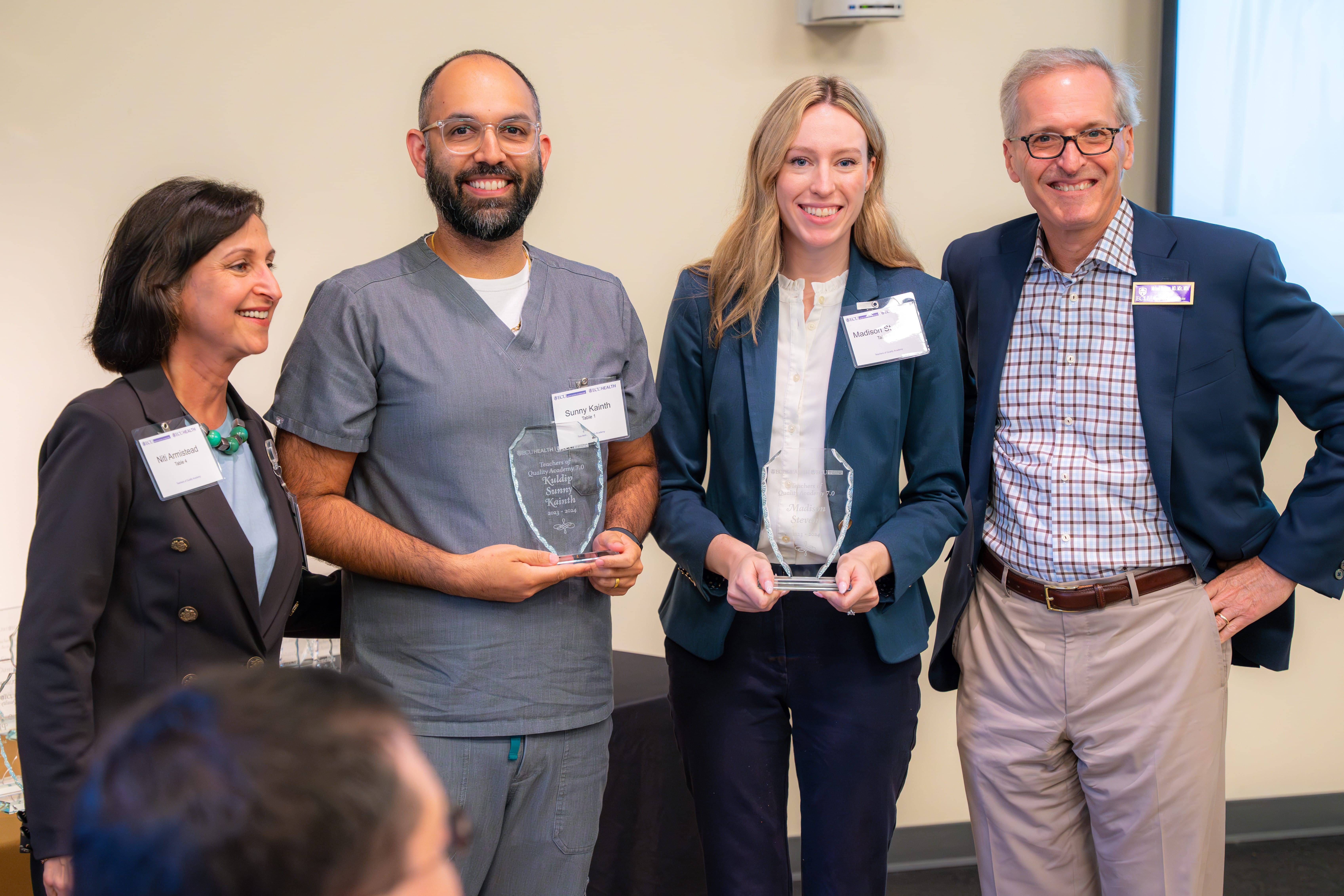
“It is exciting for us as program leaders recognize and celebrate these dedicated health care professionals for successfully completing TQA,” Sutter said. “Those of us involved in the program have been fortunate to witness incredible growth from our 7.0 cohort. We could not be more proud of what they’ve accomplished and how they will use their knowledge and skills to help further high-quality care in their individual clinical setting through out eastern North Carolina.”
The seventh iteration of the program was comprised of 12 half-day sessions alternating concepts of leadership development and new competencies of Health Systems Science, including patient safety, quality improvement, systems thinking, population health and team-based care. Each learning session also emphasized wellness topics enabling participants to engage in supplemental activities to further enhance the experience of life while at work. The year-long program culminated in each participant completing a comprehensive quality improvement project in their area of focus.
“As part of TQA, I had the honor of partnering with leaders from our community hospitals—North, Chowan, and the Medical Center—all of whom shared a commitment to serving our community,” said ECU Health administrative fellow Madison Stevens, a member of the 7.0 cohort. “The sessions empowered us to explore and refine our leadership philosophies, building a strong foundation rooted in quality improvement, professional growth, and innovation. The program has equipped me with the tools to become an effective and open-minded leader. In our project, my team focused on post-event debriefing in the emergency department, prioritizing the well-being of our team members alongside clinical learning to help teams navigate high-stress situations and improve patient care outcomes. We look forward to sharing our results and broadening our focus on quality improvement to provide exceptional patient care.”
The TQA curriculum is also designed around experiences that span the continuum of care in multiple areas of clinical focus which enables participants to be better prepared to meet real-world challenges. This intentional design, according to ECU Health Chief Quality Officer and Chief Clinical Officer Dr. Niti Armistead, enables TQA graduates to immediately help drive quality improvements in the clinical environment.
“TQA is so important because it creates a community of interdisciplinary professionals committed to improving quality both here at ECU Health and beyond,” Dr. Armistead said. “Quality is a critical component of our quintuple aim and the work being done by TQA program leaders and participants directly ties to our ability to improve the health and well-being of the region. Through TQA, participants learn by doing and acquire collaborative problem resolution skills to drive continuous improvement.”

In September, the Healthier Lives at School and Beyond program, an initiative led by the Brody School of Medicine at East Carolina University and ECU Health, hosted an event at Rose Hill-Magnolia Elementary School in Duplin County to help keep 51 students in school by providing health assessments for students.
In North Carolina, students without a health assessment or immunization record on file 30 days after the start of the school year are suspended from school which can disrupt the learning experience.
In previous years, the Healthier Lives at School and Beyond team also visited schools in Jones County and Clinton City Schools in Sampson County to ensure students are up to date on their care and can remain in the classroom.
Dr. Kristina Simeonsson, professor of pediatrics and public health at Brody, said these events are crucial for rural areas like Duplin, Jones and Sampson counties who do not have the same access to primary care as larger counties.
“These are often children who are new to the area, new to the state and possibly new to the country, who haven’t had a chance to establish with a health care provider but desperately need these health assessments done,” Dr. Simeonsson said. “We do these events in September in partnership with the county or city schools along with the county health department to get as many kids seen as possible so that they won’t miss school.”
Healthier Lives at School and Beyond was originally designed as a school-based telehealth program that provides quality nutrition education and counseling, behavioral health, and acute minor medical care services. It officially launched in 2018 to deliver interdisciplinary services virtually to rural school children, staff and faculty during the school day. Whether in school or at home, all appointments take place over a safe and secure online network which allows patients to stay at school or home and parents to stay at work or home.
But in 2020, when many community members had not seen a primary care provider due to the COVID-19 pandemic, the team received a request from Duplin County schools to catch students up on health assessments. The following year, the team realized the need was larger than they anticipated and the program eventually spread to other areas of eastern North Carolina.
“We thought that was a unique situation for COVID and wanted to do everything we could to support our school partners,” Dr. Simeonsson said. “We’ve seen this program grow because there are just so many kids that need the service. Every year we’ve tried to tweak and get a little more efficient, we’ve had medical students, residents and nurses come back if they’ve done this before to help out. Every year we’re getting a little more efficient.”

During the visit to Rose Hill-Magnolia Elementary School in September, Dr. Simeonsson said the team chartered a retrofitted motorcoach from ECU Transit to provide further screenings.
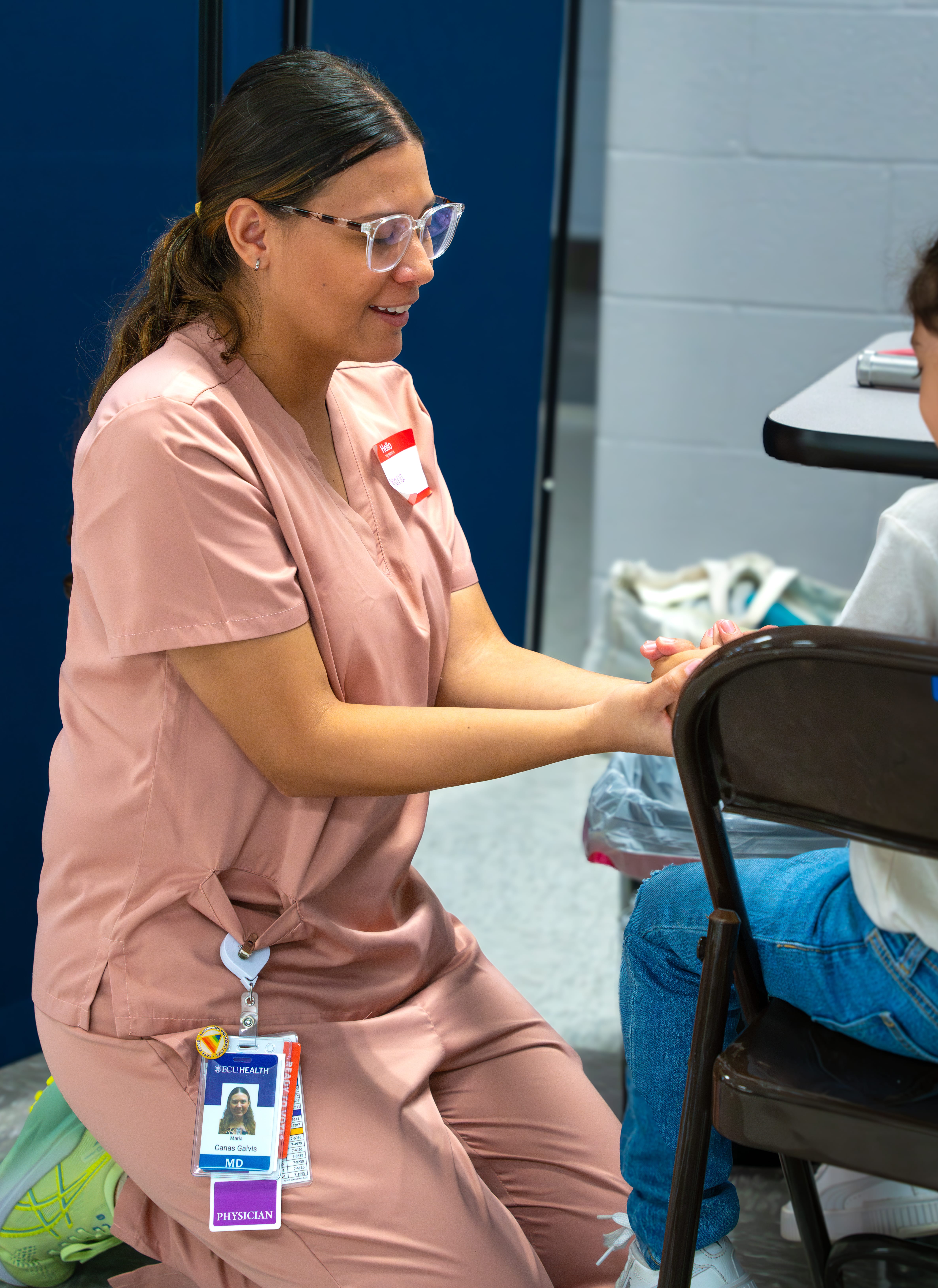
Six physician residents from ECU Health and three medical students from Brody were on hand to help for the Rose Hill-Magnolia Elementary School event. Among the residents were Dr. Maria Canas, a first-year resident, and Dr. Cady Hansen, a third-year resident.
Dr. Hansen said from a training perspective, the experience is invaluable.
“I think exposure and getting out in the community is so important,” Dr. Hansen said. “We’re connecting with the community and we’re treating patients, but it’s more than that.
This allows us to get a much different perspective into the levels of medicine needed in different areas and what people have access to and trying to ensure that we provide the best level of care across populations.”
Dr. Canas, who is from Colombia, was able to connect directly with Spanish-speaking students and families while providing care at the school. She said being a resource for Spanish-speakers made the day special for her.
“I love that. I really appreciate this opportunity,” Dr. Canas said. “It’s really nice because sometimes I get comments like, ‘I’ve never seen a provider speaking Spanish.’ It’s just nice because they can feel a little bit more comfortable speaking to me because it’s the same language and it’s not easy when you don’t have that.”
Sue Ellen Cottle, lead school nurse for Duplin County Schools, said the day was a success and each year she looks forward to the team coming together to do this important work. To date, 354 health assessments have been completed which have enabled 354 students to remain in school.
“We are very fortunate in Duplin County to have the partnership with Brody and ECU Health because otherwise these students would be out of school as of tomorrow morning,” she said. “We’ll do everything from pre-K through 12th grade today, physicals, immunizations, whatever they need to stay in school. We’ll see 51 students today and we’re just thrilled to partner with the team on this.”
Through programs like Healthier Lives at School and Beyond, Brody and ECU Health are living their missions in important and unique ways. The program is exposing Brody medical students and resident physicians to unique care environments and is working to increase the supply of primary care physicians serving the state ultimately to improve the health and well-being of the region. For ECU Health physicians and team members connected to the work, it directly drives forward the mission to improve the health and well-being of eastern North Carolina.
Working together with local partners makes the East a stronger, healthier community and helps ECU Health and Brody meet community members where they are to deliver high-quality, compassionate care.

The Teachers of Quality Academy (TQA) at the Brody School of Medicine at East Carolina University and ECU Health officially welcomed its 8.0 cohort, comprised of a group of multidisciplinary health care professionals committed to quality improvement, leadership development and improved patient outcomes, at its first learning session on Sept. 19.
TQA 8.0 is a professional development program for health care leaders designed to fundamentally change care delivery through a curriculum focused on building knowledge and skills in Health Systems Science which comprehensively explores how health care is delivered. Participants engage in advanced learning in quality improvement, patient safety and team leadership, develop improvement projects to apply these skills across the health system, teach others in their environment about these concepts and evaluate the outcomes of improvement interventions. Leading by example, TQA participants promote a culture of quality and safety across the enterprise.

“Our goal is to help participants take the lessons they learn in TQA back to their clinical areas,” said Dr. Jennifer Sutter, TQA physician director. “It is important that we use this opportunity to equip and empower our leaders to be quality teachers for their colleagues and teammates in order to improve patient care across the system.”
With 36 learners in TQA 8.0, participants spent their first learning session gaining invaluable knowledge about quality, the role it plays in high quality care and the impact it has on ECU Health’s mission to improve the health and well-being of eastern North Carolina. The newest cohort includes health care professionals from clinical, administrative, leadership and educational backgrounds, all of whom were selected from a highly-competitive pool of applicants. The cohort is comprised primarily of ECU Health team members but also features, for the second time, participants from outside the health system.

In one of the main team-building activities during the first learning session, groups of participants worked together to build paper airplanes. The catch? The airplanes had to be built quickly and to exact specifications. The activity helped reinforce key themes that will be instrumental to the year-long TQA experience: communication, teamwork and focus on details. The lessons are all designed to help participants create a Quality Improvement Project at the end of the program.
“Their growth throughout the program is going to be tremendous,” said Dr. Amy Campbell, quality nurse specialist at ECU Health and one of the quality coaches. “The airplane project is a great example of what they’ll experience in TQA. At first it can be overwhelming, but it helps them problem solve and then apply those lessons to their quality projects. Learning that connection between quality and patient experience can help us all provide better care and reach for better outcomes.”

The Brody School of Medicine at East Carolina University is among the top-performing medical schools in the country when it comes to providing an affordable education for future clinicians, according to a new study from the American Association of Medical Colleges.
Nationally, four out of five medical school graduates finish their education with more than $100,000 in debt. As part of its mission to train the next generation of physicians committed to serving the state, with a strong focus on training family care providers, Brody-trained physicians receive one of the highest-value medical educations in the country.
“It is exceptionally gratifying to know that the Brody School of Medicine is leading the way in making a career in medicine affordable and accessible for future physicians across North Carolina,” said Dr. Michael Waldrum, dean of Brody and CEO of ECU Health. “The tremendous need for more physicians, particularly those who practice family medicine and serve in rural communities, serves as our compass as we continue toward our mission. We are fortunate that this need is widely recognized by statewide leaders who are committed to supporting us in our mission. This recent report from the American Association of Medical Colleges is a reminder of why Brody is such an important asset for North Carolina and its citizens.”
The financial flexibility that Brody-trained physicians have upon graduation directly supports the medical school’s ability to produce family medicine physicians which is among the highest-need specialties nationally, particularly in rural communities. Brody ranks in the top 10% of U.S. medical schools for graduating physicians who practice in the state, in primary care and in underserved areas. Brody’s most recent class – the Class of 2023 – is a snapshot of Brody’s unique mission, with 52% of graduates matching into primary care residencies, including obstetrics and gynecology, and 44% matching to residency programs in North Carolina.
“The Brody School of Medicine has a rich legacy of preparing mission-driven physicians who touch the lives of so many through a career in health care,” said Dr. Jason Higginson, executive dean of Brody. “Not only do our medical students receive a high-quality education at Brody, they graduate supported and well-prepared to join the physician workforce and enter areas of practice that are most needed, like family medicine. I could not be more proud and grateful of the Brody faculty and staff. Their passion and expertise make our academic health care mission possible.”